Cannabis Social Clubs: is France ready?

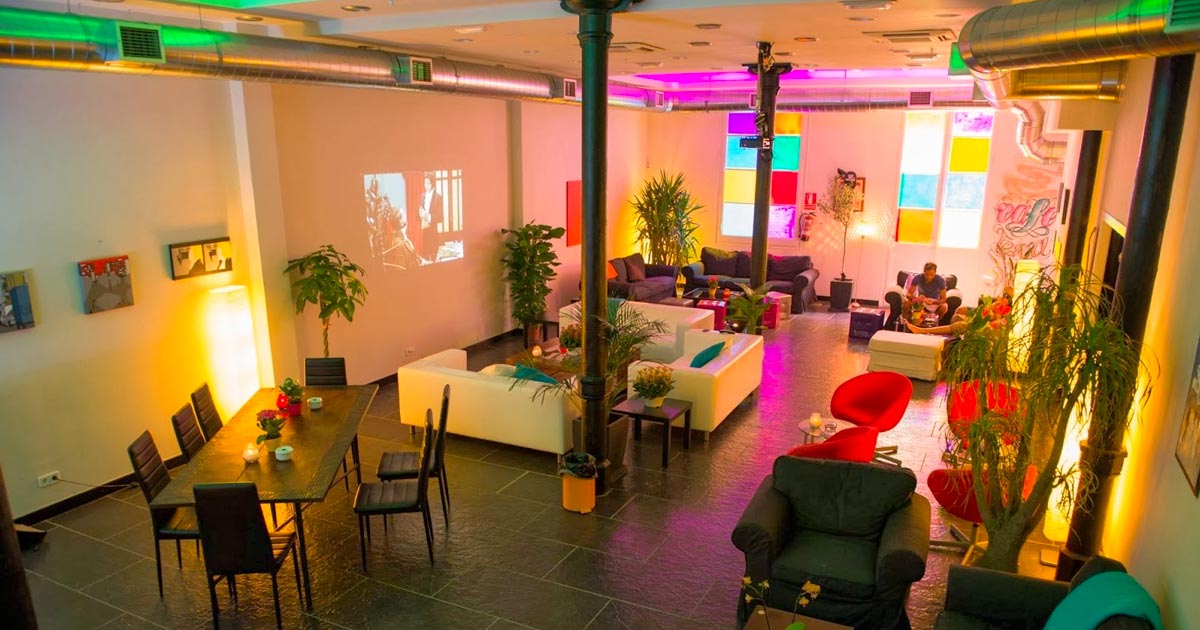
After the dissolution of the CSCF in 2014, and an oversight in the National Assembly's questionnaire, the Cannabis Social Clubs (CSC) model is back in the spotlight, particularly for its health and economic benefits. Is France finally ready for CSCs?
What is a CSC?
The expression Cannabis Social Club refers to an economic model of access to cannabis in a closed circuit within a non-profit structure: in France, associations loi 1901, ASBL in Belgium...
A CCS generally aims to Reduce Damage and Risk (RDR). related to cannabis use. These risks can be both health-related and legal. CSC profits can be reinvested within the association to help achieve this objective. For example, we can
- renting a place to consume to reduce the risks of repression,
- purchase of vaporizers to reduce health risks within the premises,
- employing more staff to look after the plants and improve harvest quality,
- increase salaries or improve working conditions, to enhance the quality of reception,
- financing staff training and even members' training...
In this way, the CSC represents a business model that improves qualitatively over time. Profits can also be reinvested outside the association, for purposes that contribute to the objective: research, RDR programs, prevention, social action...
The beauty of this model is its variable geometry. CSCs take very different forms in different countries, regions and neighborhoods. What do they have in common? They are all based on bringing together cannabis users and growers within a structure that allows them to share harvests and costs on a closed-circuit basis: closed circuit for access to products (restricted to members) and for profits (directly reinvested in the CSC).
Sometimes misunderstood, the CSC model does not necessarily correspond to a very small structure, with very few members, operating without making any profit. On the contrary, like any other association, a CSC can be small and local (like a neighbourhood association) or much larger in terms of membership and scope (just as there are huge associations like Médecins du Monde).
An association is simply an agreement between several citizens to share their knowledge and/or activities for a purpose other than individual profit. This does not mean that profit is forbidden: it means that it must be reinvested in the association., or in other activities that further the association's objectives. Likewise, CSC does not necessarily mean volunteering. All work deserves remuneration, even in an association. In Spain, for example, 75% of CSCs legally employ some of their members. They pay taxes through social security contributions, even in the absence of official legalization! In France too, it's theoretically possible.
Researcher Mafalda Pardal neatly summed up the variable geometry of CSCs in a 2018 article. Basically, it's a mixing table of how CHCs are organized internally:
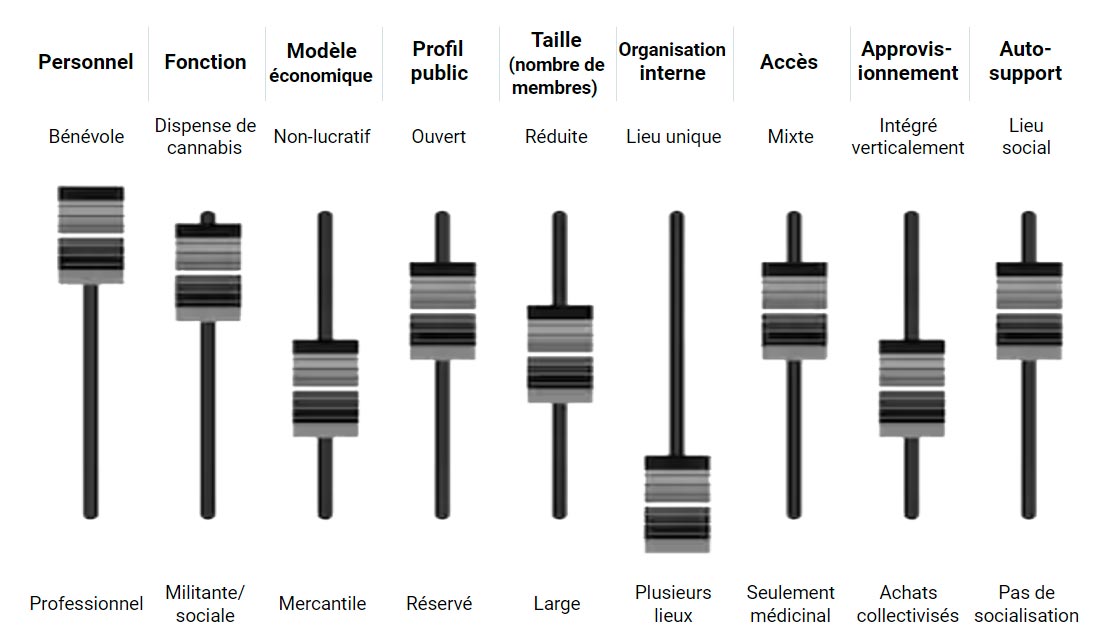
Source : Ghehiouèche and Riboulet-Zemouli (2021). Tomorrow, the CSCs?
Adapted from : Pardal (2018). An analysis of Belgian CSCs’ supply practices: a shapeshifting model?
CSC in France
In France, a similarity exists with AMAP (Associations pour le Maintien d'une Agriculture de Paysanne), a kind of CSC for vegetables. But Cannabis Clubs are part of a wider social movement: they first appeared in Spain in the 1990s, were popularized by the European NGO ENCOD in the 2000s, were championed in 2012 by the Uruguayan citizens“ platform ”Responsible Regulation", and were incorporated into the legalization law the following year.
At the same time, in 2013 in France, the government put the finishing touches to the Fédération des CSC français (CSCF), headed by the high-profile Dominique Broc, by dissolving it through the courts one year later its creation on July 14, 2012 -whereas the dissolution of an association is generally reserved for groups inciting hatred, but not for citizens' groups targeting RDR...
Despite this, the idea of a cannabis market model with a human face represented by CSCs has continued to gain ground in France: in 2016, the association NORML France organized a series of meetings, a rich database of French-language documentation on CCS. More recently, CCS made its appearance in a written contribution and in the hearings of the National Assembly's Information Mission.
Why CSC?
The interest in CSCs is twofold: firstly, the model of a social, supportive, responsible and non-disposable economy that CSCs represent makes them an important potential vector of employment, in the event of regulation of the adult use of cannabis.study of data from Spanish CHCs suggests that regulation through CCS could potentially represent three times as many jobs as regulation through a more “traditional” market model. CCS count between 1 and 23 employees per CSC, A much higher employee/user ratio than the Amsterdam coffee shop model or French tobacconists.
On the other hand players in the health and social sector welcome the fact that CSCs represent a model with no access for minors, no shop windows, no advertising, less likely to generate mass cannabis tourism, facilitating the integration of underground market players wishing to join the legal sector (as demonstrated in Spain), and a fundamental opposition to oligopolies and other possible “Big Cannabis”.
At a time of pandemics, climate change and Suez Canal bottlenecks, the local, humane, fair, safe and healthy economic model of CCS seems more necessary than ever.



























Medical Cannabis in Germany: THC Prices Vary by a Factor of 12

France already has 3,000 cannabis retail outlets. None of them are legal.

Morocco's exports of legal cannabis have expanded to 15 countries

Aurora Cannabis Doubles Its Production Capacity in Germany

Tilray is accelerating its operations in Europe thanks to a license in Portugal

Boston will host the 10th annual State of the Cannabis Industry Conference on October 26

A DEA report confirms that there are no fatal cannabis overdoses

A British patient is challenging the NHS's refusal to reimburse medical cannabis

October 2026 CBD Highlights: 10 Strains and Hash to Discover from 5 French Producers

CBD in France: Traceability, Retail Stores, THC and Driving… What the New Bill Proposes
-
 Business2 weeks ago
The legal cannabis market in New York exceeds 4 billion $ in revenue
-

 Cannabis in France3 weeks ago
Which countries legalized medical cannabis before France?
-
Business3 weeks ago
South Korea is preparing to begin local production of medical cannabis to meet rising demand
-
Cannabis in Thailand3 weeks ago
From the boom in dispensaries to a purely medical approach: Thailand is revising its cannabis policy
-
Cannabis and driving3 weeks ago
Medical Cannabis and Driving: New South Wales Ends Automatic Penalties for THC
-
Cannabis in Argentina4 weeks ago
Argentina Opens Its Market to Hemp Flowers Containing 1% of THC
-
Autism3 weeks ago
Autism and Cannabis: Results from the First Placebo-Controlled Trial of NTI164
-
Cannabis in France2 weeks ago
France’s Drug Policy Chief Defends Cannabis Prohibition... and Runs Into the Facts

















You must be logged in to post a comment Login