
Cannabis Europa London 2026: Key points, Day 1

Cannabis Europa London is back at the Barbican Centre for two days of debates bringing together world leaders in the cannabis sector, policy-makers, industry analysts and patient representatives, and, as always, the sun is out.
«Cannabis Europa is still blessed with great weather,» Stephen Murphy, co-founder and CEO of Prohibition Partners, told delegates at the opening of proceedings.
As has now become a conference tradition, hundreds of delegates repeatedly invade the Barbican's sunny courtyards between sessions, bonding amid the center's striking Brutalist architecture, or ducking inside to listen to the industry's most influential voices debate the issues reshaping the market.
Despite this familiar buzz, this year's conference is unique. Cannabis Europa 2026 is the industry's first major gathering since the United States have reclassified cannabis in category III, the most significant change in federal drug policy in half a century. This reclassification permeated almost every conversation on the opening day of the event, both on stage and backstage.
According to Prohibition Partners, the European market for legal medical cannabis is expected to exceed 1.5 billion euros, and the US reclassification decision, which for the first time officially recognizes the medical benefits of cannabis at federal level, has brought the US and European regulatory frameworks closer together than at any time since legalization began. What this convergence means for operators, investors and patients on both sides of the Atlantic has become this year's central theme.
As always, we'll be guiding you through the key sessions and viewpoints as the day progresses, updating our (almost) live coverage throughout.
Stephen Murphy kicked things off by drawing a direct link between the origins of Cannabis Europa and the current state of the sector.
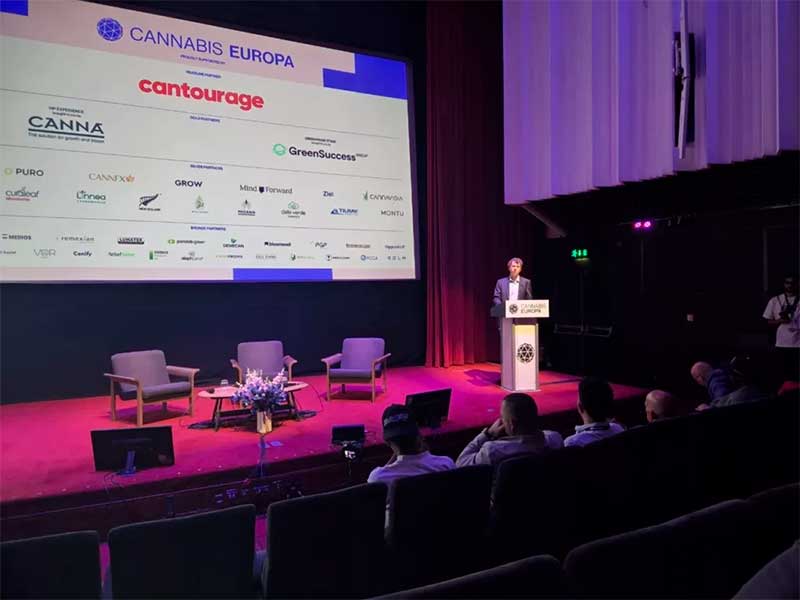
Stephen Murphy's opening speech
«We met for the first time in 2018,» he told delegates. «Back then, the conversation was very theoretical. Today, it's very concrete: we're talking about the realities of large-scale patient supply.»
He called on established figures in the sector to be generous in sharing their time and knowledge with those entering the field, presenting this openness as a collective responsibility.
«It's ultimately our responsibility to lay the foundations for what we hope will be a very progressive, sustainable and ethically based industry.»
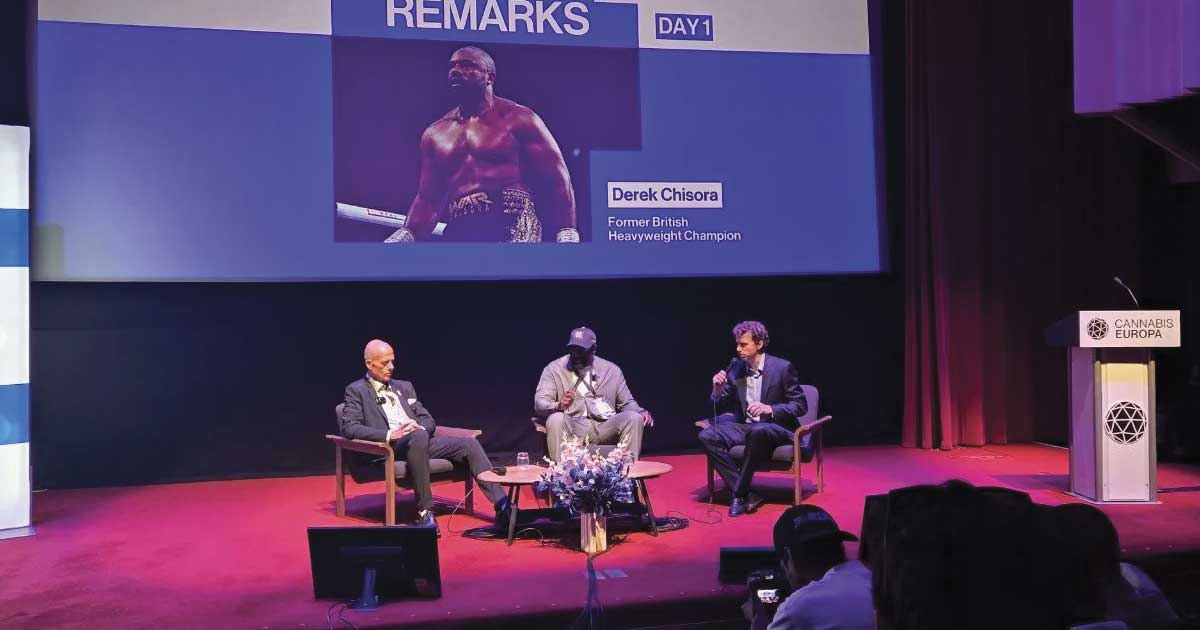
Opening session: Derek Chisora and Pierre Van Weperen, Grow Group
Opening session of Cannabis Europa London 2026
The conference began with a personal testimonial, a deliberate choice which Stephen Murphy presented as essential to changing attitudes within the industry. Former world heavyweight title contender Derek Chisora took to the stage alongside Pierre Van Weperen, Managing Director of Grow Group Limited, to announce the launch of WarOnPain, a patient education platform focused on legal access to medical cannabis in the UK, and to reveal that he himself consumes medical cannabis on prescription.
- Van Weperen pointed out the inherent limitations of the sector. Clinics are not allowed to use the word «cannabis» in their advertising, while many delegates no doubt saw it all over London's billboards on their way to the event.
- In his view, the industry risks talking only to itself. «If, as an industry, we start talking about cannabis, it will just be seen as advertising; we'll just be talking to an echo chamber,» he said.
- High-level athletes reach an audience of 20 to 30 million people, he argued, a population that the sector has so far failed to reach. He pointed to the 8 million people on NHS waiting lists for pain management and mental health assessments. «It's actually ridiculous that we're not doing anything,» he said.
- Van Weperen said the industry was still struggling with stigma, and Chisora's willingness to speak out publicly was rare. «I wish there were more people like Derek,» he said. «We know a lot of celebrities use cannabis, but are afraid to speak out.»
- Chisora was frank about the extent of discreet consumption among elite athletes. «The top ten athletes in the world use cannabis, but they don't want to talk about it,» he said. «To sleep, to recover. Training hard eventually catches up with you. What's the best solution? Pills that damage your kidneys?»
- He said the reaction to his announcement was immediate. «It's already blown up,» he said of his phone after the news hit the mainstream media that morning.
- WarOnPain's educational model, built around long-form video content and regulated clinical pathways, is designed to offer these athletes, and the millions of people they influence, a visible and legitimate path to explore. The platform can be accessed at waronpain.com.
Rebuilding cannabis as healthcare: where is European medical cannabis headed?
Yuval Soiref, Green Success; Aras Azadian, Avicanna
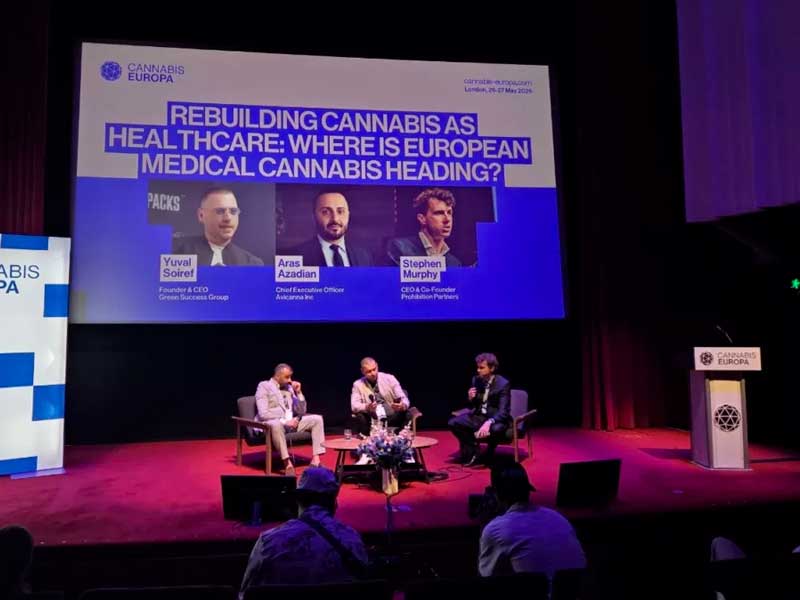
Conference «Redefining cannabis as health care».»
As U.S. reclassification focuses North American attention on the European healthcare model, this session examined where the industry is heading from hard-won credibility rather than mere hype.
- Aras Azadian, co-founder and CEO of’Avicanna, In his presentation of medical cannabis as a service rather than a product, a service that requires patient support, medical affairs, dosage advice and clinical infrastructure, not simply a prescription and a product to fill it.
- Regarding the move towards standardized formats, Azadian said, «To get a reproducible result - something a doctor can actually prescribe and expect results from - you have to move away from flower.» It's in cannabinoid-based medicines, with standardized dosing, that clinical credibility lies.
- Fortune 100 and Fortune 500 companies are starting to move. «I've seen a dramatic change in tone over the last three months compared to what I've seen over the last nine and a half years,» Azadian said. «Once the Americans get here, it's going to be rough.»
- Yuval Soiref, CEO of Green Success, singled out fragmentation as the sector's main structural problem, and argued that the solution lies in a connected, AI-driven infrastructure that unifies patient acquisition, retention and operational data, rather than the siloed models that characterized the first wave of cannabis start-ups.
- Mr. Azadian drew a direct parallel between today's European market and Canada prior to the legalization of recreational use, and warned that the shift in product formats that has occurred in Canada will also occur here: away from smoking flowers towards oils, sublingual and oral formats, driven by both clinical preferences and pressure for harm reduction.
Policy in practice: from workplace testing to driving - what impact does UK legislation have on patients?
Richard List, Association of Police Controlled Drug Liaison Officers; Robert Jappie, Fieldfisher; Sal Aziz, PatientsCann
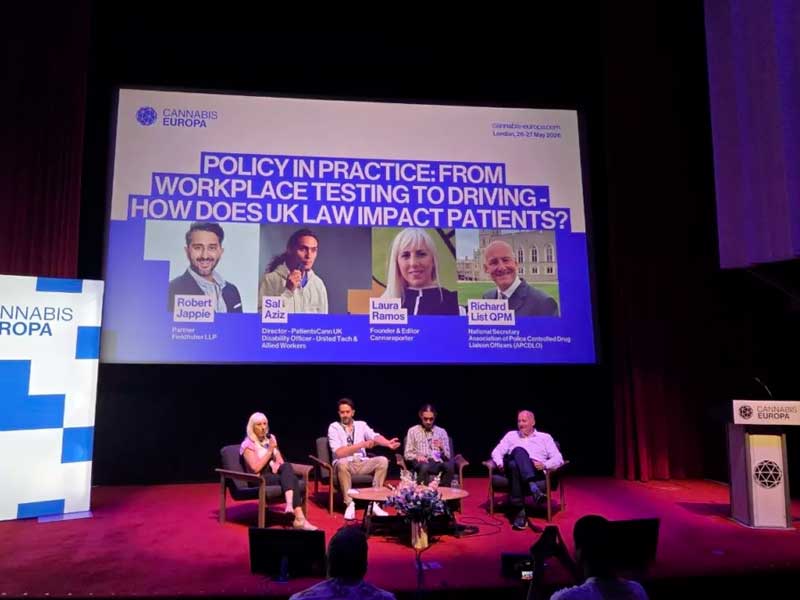
Politics in practice« conference»
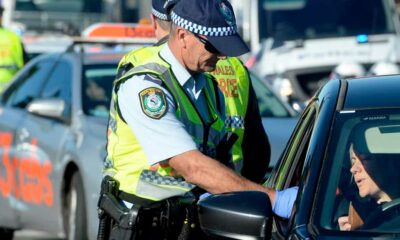
Eight years after the legalization of medical cannabis in the UK, police officers continue to stop, arrest and prosecute patients for legal possession of their prescription medication. This session clearly explained why, and who is responsible for remedying this situation.
- Richard List, retired chief constable and former head of drug enforcement at Thames Valley Police, was frank about the scale of the problem in the UK. Duty officers« knowledge of medical cannabis remains extremely limited, including, in many cases, simple awareness of its legality. »Patient first, suspect second," he said, describing the fundamental principle of the National Police Chiefs' Council guidelines he drafted, guidelines which, he acknowledged, have so far had only limited impact in operational practice.
- Negative incidents with the police, stops, searches and arrests continue to be reported regularly, and are almost exclusively the work of officers who simply don't understand the law they are charged with enforcing.
- Sal Aziz of PatientsCann, speaking as a patient, added: «As patients, it's not up to us to explain the situation to them at the time,» he said.
- The session's liveliest exchange concerned driving under the influence of drugs. Robert Jappie, Fieldfisher's cannabis regulatory attorney and former criminal lawyer, said, «Ignorance of the law is no excuse, it's what the police tell suspects. How is it that, eight years later, officers are still ignoring the law?»
- The legal framework compounds the problem. Under the current Highway Code, a medical cannabis patient stopped on the road can only invoke his or her legal medical defense after being pulled over, taken to the police station and subjected to a blood test. There is no mechanism for resolving the issue on the spot, whether or not the patient has his or her prescription with him or her.
- List described two pieces of legislation that contradict each other in practice: the 2015 DUI regime, designed for illicit substances, and the 2018 legalization of medical cannabis, which has never been accompanied by updates to police procedures or traffic laws. «The people caught in the middle are medical cannabis patients,» he said.
- List's association is currently drafting a second edition of the NPCC guidelines, with a considerably expanded section on driving. His position, which he made clear was not shared by all, was to test for impairment using the established five-point field test, check prescription documents at the roadside and reserve blood sampling for cases where there is reasonable suspicion of concomitant illicit drug use. «I want to avoid medical cannabis patients ending up at the police station,» he said. «The police should not be interfering in health care.»
- Jappie proposed adapting the existing «production» mechanism used during roadside checks, requiring a patient to present his or her prescription, pharmacy label and ID to the police station within seven days, rather than being stopped on the spot. If the documents match, that's the end of the matter. Failure to do so would have the same consequences as refusing to provide a sample in a DUI case.
- Jappie concluded with a blunt challenge to the assembly. «I think the industry itself needs to do more to protect patients, because they are your customers,» he said. «One of the main arguments for legalization should be that you're not harassed by the police, or your employers, or your landlords. Unfortunately, that continues to happen.»
Cannabis in international law: is gradual progress enough?
Kojo Koram, Centre for Transnational Research on Emerging Drug Markets; Carola Perez, We, The Patients; Steve Rolles, Transform Drug Policy Foundation; Simone van Breda, Union of Coffeeshop Retailers
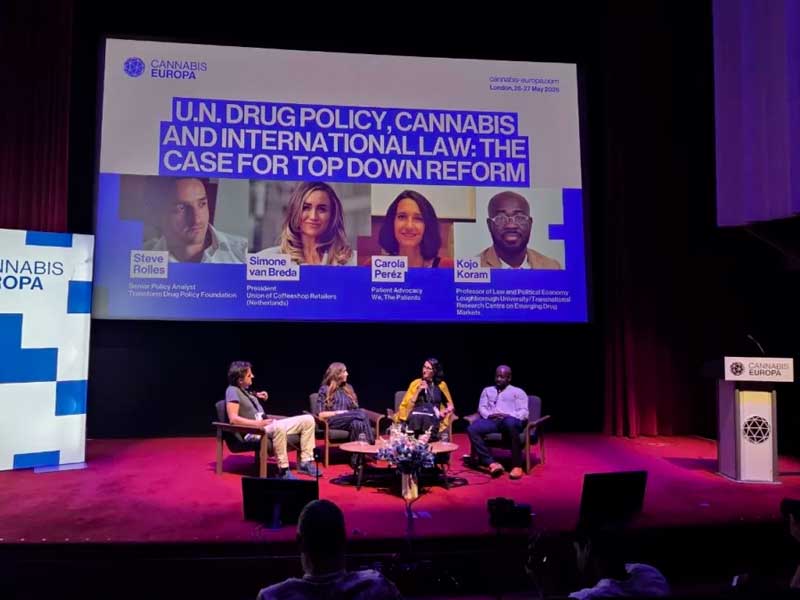
Cannabis in international law« conference»
- Carola Perez opened the discussion by challenging the industry to look beyond its own markets. «We need to think about all the zip codes around the world,» she said, referring to patients in the Caribbean, South America and Asia regularly excluded from access discussions. Regarding structural patient representation, she said: «Patients are represented, but we only have a consultative voice. This is not structural participation. Patients don't have a say, and that's a huge difference.»
- Kojo Koram placed international prohibition in its historical context, pointing out that the roots of the 1961 Single Convention go back to 1948, one of the very first initiatives of the new UN system. Its near-universal adherence, he argued, was not the result of an organic evolution: «It's not because Jamaica, Morocco or Egypt suddenly decided they wanted to ban cannabis. You had to sign up to become a member of the international community.»
- As to whether meaningful reform can emanate from the UN, the panelists agreed that it was unlikely to come from within the organization itself. «Drug reform has always been a bottom-up process, driven by local activists, patient groups and traditional growers,» said Steve Rolles of the Transform Drug Policy Foundation. «Sometimes, when reform has proven itself, it reaches the UN level and ripples out to places that haven't yet implemented it. But the impetus has always come from the bottom up.»
- Koram highlighted a growing division within the UN itself: the Office of the High Commissioner for Human Rights has called for the legalization and regulation of all drugs, placing it in direct conflict with the UN Office on Drugs and Crime, which oversees the global fight against narcotics.
- Regarding countries in the South, Koram warned that cannabis industries in countries like Ghana are developing primarily to serve export markets in Europe and North America, relegating local health needs and indigenous medicinal traditions to the background. «This ignores the enormous need for painkillers within these communities and diverts traditional and informal processing mechanisms away from local interests and towards the consumer market of the North.»
- Perez used Spain as an example. «Spain is the world's seventh largest producer of medical cannabis, and the law only allows oils. If you're a chemotherapy patient, you're not going to wait, you're going to go out on the street. In the UK, there are only eight prescriptions under the NHS. This medicine is sometimes reserved for the rich.»
- Koram concluded by warning the industry against the risk of corporate-led reform without the buy-in of patients and the activist community. «When change is driven entirely by corporate interests, it exposes these players to a backlash. Prohibition could wipe out everything in one fell swoop. The lack of a long-term vision regarding common interests between activist communities, patient communities and industry players has exposed reform in many countries to this precise risk.»
All eyes on Germany: the path to profitable growth and consolidation
Tristan Gervais, T Capital; Niklas Kouparanis, Bloomwell; David Henn, Cannamedical; Franziska Katterbach, Oppenhoff; Benedikt Sons, Cansativa
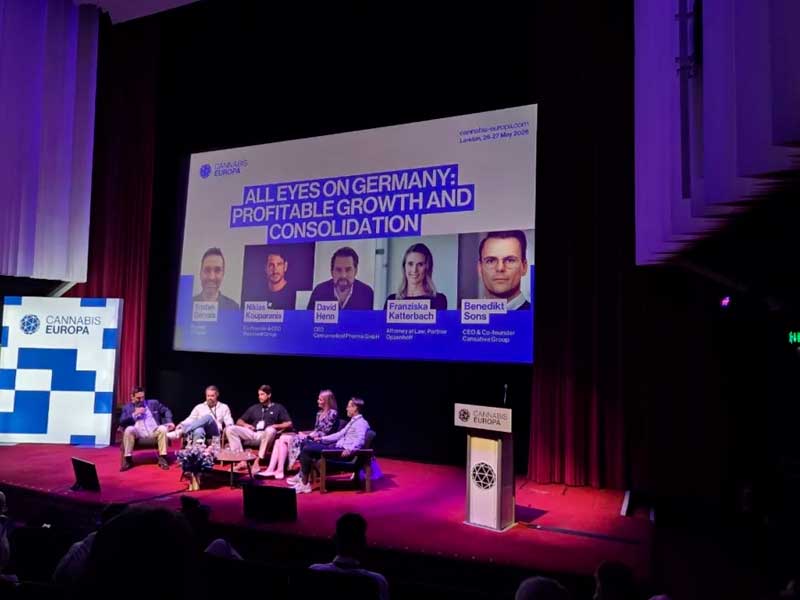
Eyes on Germany« conference»
One of the most eagerly-awaited roundtables of the day drew a full house, and the session lived up to its title.
- Deutsche Bank's entry into cannabis financing has been described as a watershed, not only for what it opens up, but also for the signal it sends. The bank has confirmed that it is open to new transactions, but only companies with sales in excess of €20 million are being considered, and the focus is clearly on supporting winners rather than accumulating market share. Working capital financing for profitable German operators, the panel noted, is now accessible and relatively straightforward.
- Franziska Katterbach, Partner at Oppenhoff, told the audience, «The sector is undergoing a renaissance, with major M&A deals and loans from major banks. We need to seize this opportunity and capitalize on it intelligently.»
- Niklas Kouparanis, CEO of Bloomwell, outlined four archetypes of consolidation that he expects to shape the market: German companies buying German companies; the arrival of Canadian operators; a second wave of US multi-regional operators (MSOs), who he believes now need a presence in Germany to justify their pitch to their stakeholders; and the pharmaceutical, tobacco and food giants already circling the market. «I think these are the four main consolidation players in Germany,» he said.
- David Henn, CEO of Cannamedical, urged the meeting not to lose sight of the bigger picture. «The biggest deals in Germany are still to come. I firmly believe that there will be considerable growth over the next five years. We've been waiting for this moment for ten years.» His warning was equally blunt: «I think you should concentrate on building a business rather than wasting time looking at multiples and worrying about M&A.»
- Benedikt Sons, CEO of Cansativa, was unambiguous about the market's evolution. «Everything is now based on profitability; revenues have lost their importance.» Wholesale multiples have shrunk to around six times EBITDA, he said, but companies with genuine technology platforms and patient services can achieve multiples of ten to fifteen times EBITDA in the healthcare technology sector.
- Katterbach said of the current spirit of M&A: «You're really buying execution, not a piece of paper.» The structures of recent deals bear witness to this, with earn-out clauses approaching fifty percent in some deals, placing the burden of proof on the sellers to demonstrate that the business will perform.
- She added: «Demand is so strong in Germany that we can now see what the traffickers have left. The product has always been traded. It's simply on the legal market now.»
- Henn pointed to a structural challenge that the German market has yet to fully face. «The German mentality is perhaps the problem here; American investors are far more aggressive and bold when it comes to building international businesses.»



















CBD is said to promote athletic recovery, without improving performance

294 cannabis clubs in Chile: a booming movement with uneven distribution

Chronic Sciatica: New York Approves First Clinical Trial of a THC-Based Medication

United States: The DEA is accelerating the integration of medical cannabis at the federal level

Florida is nearing one million patients using medical cannabis

Uruguay Revives Its Plan to Allow Tourists to Legally Access Cannabis

In Brazil, researchers are developing an innovative CBD eye drop

Autism: Medical Cannabis Is Linked to Reduced Anxiety

The $28 billion U.S. hemp market remains under threat

Jamaica Eases Small Farmers' Access to the Cannabis Market
-
 Business6 days ago
The legal cannabis market in New York exceeds 4 billion $ in revenue
-

 Cannabis in France2 weeks ago
Which countries legalized medical cannabis before France?
-
Business2 weeks ago
South Korea is preparing to begin local production of medical cannabis to meet rising demand
-
Cannabis in the Netherlands4 weeks ago
One year after the launch of the Dutch cannabis experiment, the first trends are emerging
-
Cannabis in Thailand2 weeks ago
From the boom in dispensaries to a purely medical approach: Thailand is revising its cannabis policy
-
Cannabis in France4 weeks ago
French medical cannabis remains stalled at the Ministry of Health
-
Cannabis in Argentina3 weeks ago
Argentina Opens Its Market to Hemp Flowers Containing 1% of THC
-
Cannabis and driving2 weeks ago
Medical Cannabis and Driving: New South Wales Ends Automatic Penalties for THC
















You must be logged in to post a comment Login