Solvent extraction : How it works and equipment required

Content originally appeared on Légalisation Douce.
Now that the’History of mining and the processes used Now that these points are clearer to you, let's get down to business! First and foremost, it's important to remember that extractions—and especially solvent extractions—are not a «game» to be taken lightly.
The risks are real, and this guide was created solely to inform people and minimize the risk of accidents as much as possible. So if you want to get started with extraction, your first priority—even before you open your gas bottle—should be to make sure your environment is safe and free of hazards. If you haven’t read it yet, we invite you to check out our first guide, «What Is Extraction?».
Your hands are precious, and it would be a shame to lose them over 2 grams of BHO
Equipment needed for solvent extraction
Solvent extraction can be carried out very cost-effectively using the «Open Blast» method (a term referring to open-circuit extraction) or by « Closed Loop »more expensive but also safer.".
Since we prefer not to handle gas cylinders directly with our hands, here’s a look at the equipment we use ourselves to perform extractions.
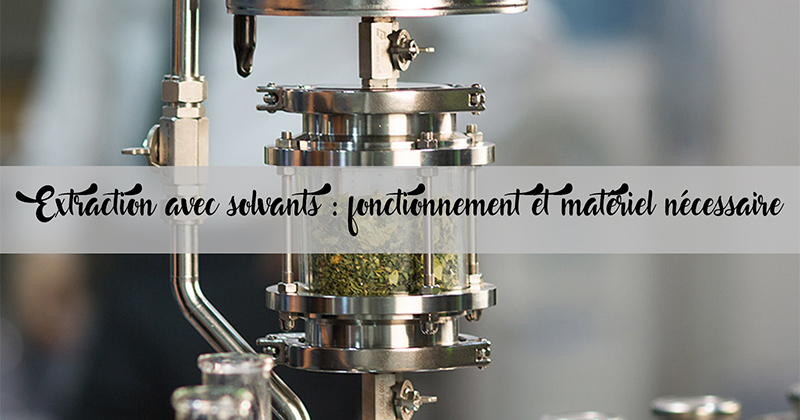
Extraction tube made of 304 or 316 grade stainless steel
The grade depends on how you plan to use your extracts. Grade 304 is approved for use in the food industry. Grade 316, on the other hand, is used in the pharmaceutical and medical industries (it contains a higher amount of molybdenum). We use an extractor from BDC.lab Tool that is assembled in France (and we really like that!). The tube is equipped with a gas injection system, a pressure gauge so you can always monitor the pressure inside your tube, and a flow valve.
Pyrex, PTFE, and parchment paper dish
PTFE, which stands for polytetrafluoroethylene (a name that’s a bit harder to pronounce…), looks like parchment paper. It’s used by most extraction labs because, unlike parchment paper, it doesn’t alter the final product. Pyrex dishes are also recommended over regular glass, which may not withstand thermal shock. It’s also possible to use unbleached parchment paper. It’s easy to find on Amazon.
Special Gas Cylinder Clamp + Metal Connector
In our opinion, this is an essential item for improving safety. If, like us, you’d rather not come into direct contact with the gas cylinder, we highly recommend this tool. Use a metal connector to attach your tube to the clamp. Once the clamp and the tube are connected, you can use the clamp to pierce the bottom of your gas canister. Don’t panic if the process seems «risky»—in our next guide, you’ll find a video detailing how to pierce your gas canister using the clamp.
Butane or DME
The choice of gas is entirely up to you. DME is considered a «cleaner» solvent because it is already used in the pharmaceutical and food industries. It allows for more powerful extraction than butane while reducing risks because it evaporates more quickly. There are a number of other solvents, but these are the main ones used for Cannabis Extracts «traditional.» Most people prefer butane for so-called extractions «Recreational» and DME for «Medical» Extractions».
Safety goggles, antistatic coveralls, and gloves
While your hands are important, so is the rest of your body. First of all, safety glasses will protect you from any flying debris.
Trust us, you don't want a mixture of gas and oil to end up there.
Surgical gloves prevent your skin from coming into direct contact with the equipment. An antistatic coverall is a «plus» that will further enhance your safety. If you don’t have one—even if it’s 2° outside—roll up your sleeves to eliminate any risk, and don’t wear that old-fashioned sweater.
An outdoor venue
This is essential for your safety, so make sure you’re outdoors. A balcony, a patio, a courtyard, a garden—whatever you like, as long as you don’t do this in your kitchen. When you pass the gas through your material and it flows down into your container, the gas will expand. This means that when you see your concentrate, you’re also completely surrounded by gas (Exciting, isn’t it?). More seriously, the evaporation of this gas isn’t dangerous as long as safety precautions are followed. There are many methods for allowing the gas to expand more safely; we’ll cover them in our upcoming guides.
The Principle of Solvent Extraction
Now that you're equipped like pros, it's time to get a better understanding of what will happen when the gas passes through your material.
What does the gas «take» from the plant?
During a Extraction is quite a process that takes place inside your extractor, so before going any further, it’s essential to understand what’s happening. Be sure to take the time to understand this section, as it’s crucial.
There are three distinct stages as the gas passes through the extractor. The first is dissolution. The gas will absorb all the nonpolar compounds from the plant.
APO what?
In the cannabis industry, we work to extract nonpolar compounds, which are the Cannabinoids : THC, CBD, CBN … A nonpolar substance is a substance with a very weak magnetic charge.
Fortunately, the gases we use for extraction—such as butane or DME—are also nonpolar gases. So when your gas mixes with your raw material, it will dissolve only the molecules it is designed to target.
And how do I know which gas to use?
This issue will be the subject of a comprehensive guide But keep in mind that with butane and DME, you'll already cover 90% of your initial needs.
The process of directing pressurized nonpolar gas toward nonpolar substances such as cannabinoids is called polarization.
Now that our material and gas are fully integrated, it's time to move on to the second step: filtration.
In «homemade» systems, you’ll often see a coffee filter at the end of the extraction tube. This helps trap particles carried by the gas that are larger than the desired diameter. Filter diameters are measured in «microns.» Diameters typically range from 25 to 200 microns for extractions, but it is possible to find diameters as small as 1 micron.
Finally, the last step is the nucleation/crystallization of your concentrate. This is when your gas and the nonpolar compounds that have passed through the filtration stage settle into your Pyrex, PTFE, or parchment paper dish.
This step is also called evaporation because the gas will separate from the concentrate. This step is exactly the same as the one that has been used for several hundred years in salt marshes. It is the universal principle of solvation.
Since the gas is no longer under pressure, it will expand and evaporate into the air (which is why it’s best to perform your extractions outdoors), while the various molecules carried by the gas will crystallize in your container.
What remains of the raw material?
Depending on the purity of the gas you use, your raw material won’t be completely useless. If the raw material is extracted with butane, it will retain many terpenes. It’s possible to extract the terpenes later using a heating flask and a cooling column, but let’s take it one step at a time.
It will also include everything that is considered «untransportable» by gas:
- Cellulose
- Organic fibers
- Anything larger than the filter you selected
What is the average yield?
The $1 Million Question! It’s impossible to answer because so many factors come into play during an extraction—and here are the main ones:
- Quality of the raw material
- Extraction system
- Refrigeration Management
- Choosing a Gas
- Quality of the purge
- Conservation
The extraction can be performed from your trim (resinous leaves) and helps preserve your flowers. Allow about 1 gram of concentrate for every 10 grams of trim, and up to 2 grams of concentrate for a good weed. With the DME, you can usually gain a few extra %, but there are also some drawbacks.
The expected result
Far from being a dangerous hard drug as M6 suggests, an extract is the very essence of a product. Contrary to the current belief that concentrates are made solely for getting high, they now have their place in the medical sector. Countless families are moving to Colorado so their children with epilepsy to receive treatment effective cannabis oil.
There are almost endless ways to consume concentrates. Vaping and dabbing are the most common methods in France, but they’re also useful for making your Edibles. For those who are most resistant to inhalation, you can make your own sublingual oils, capsules, suppositories, etc.
Finally, run some tests! And of course, don’t limit yourself to just cannabis. As we saw in our first guide, concentrates can be extracted from many flowers and plants.
So rather than starting to harvest your Kikiriki—which you've grown with so much love—try using rosemary first; it'll be much less expensive.
The expected result depends on the raw material you choose and the parameters we discussed earlier, but your concentrate can range in consistency from that of oil to that of a brittle caramel slab.
Action
Here is a video created to mark the release of the Closed Loop AKS4, a closed-loop extractor launched by BDC.LAB tool.
There's still a ways to go before you become an expert on extraction, and if you didn't quite understand the video right above, it will become much clearer very soon.
In the next guide, we'll take a closer look at the Characteristics of Solvents Used in Extraction and the results obtained with each one!





CBD is said to promote athletic recovery, without improving performance

294 cannabis clubs in Chile: a booming movement with uneven distribution

Chronic Sciatica: New York Approves First Clinical Trial of a THC-Based Medication

United States: The DEA is accelerating the integration of medical cannabis at the federal level

Florida is nearing one million patients using medical cannabis

Uruguay Revives Its Plan to Allow Tourists to Legally Access Cannabis

In Brazil, researchers are developing an innovative CBD eye drop

Autism: Medical Cannabis Is Linked to Reduced Anxiety

The $28 billion U.S. hemp market remains under threat

Jamaica Eases Small Farmers' Access to the Cannabis Market
-
 Business6 days ago
The legal cannabis market in New York exceeds 4 billion $ in revenue
-

 Cannabis in France2 weeks ago
Which countries legalized medical cannabis before France?
-
Business2 weeks ago
South Korea is preparing to begin local production of medical cannabis to meet rising demand
-
Cannabis in the Netherlands4 weeks ago
One year after the launch of the Dutch cannabis experiment, the first trends are emerging
-
Cannabis in Thailand2 weeks ago
From the boom in dispensaries to a purely medical approach: Thailand is revising its cannabis policy
-
Cannabis in France4 weeks ago
French medical cannabis remains stalled at the Ministry of Health
-
Cannabis in Argentina3 weeks ago
Argentina Opens Its Market to Hemp Flowers Containing 1% of THC
-
Cannabis and driving2 weeks ago
Medical Cannabis and Driving: New South Wales Ends Automatic Penalties for THC

















You must be logged in to post a comment Login