«Realistic and operational»: what the report says about experimenting with medical cannabis

On September 26, the French Ministry of Health should have given the MPs an evaluation report on experiments with medical cannabis.
On that date, we learned that the Ministry did indeed have three external reports in its hands, but preferred to consolidate the «recently received elements» and then bring them «to the attention of Parliament as part of the debates on the PLFSS 2023» in mid-October.
If the reports made «externally» were made on time, the Ministry preferred in any case to anticipate on its communication and conclude directly that the experiment should be extended. However, the various reports support the success of the experiment and the expectation that it will be generalized by the patients included in the experiment, for themselves and for others.
Some statistics from the report
The first report, produced by IQVIA, is 163 pages long and examines the experiment in detail: speed, typology, prescription circuit and quantity, age and location of patients treated, satisfaction of doctors and pharmacists...
Front page of IQVIA report on French medical cannabis trials
The report begins by outlining the objectives of the French therapeutic cannabis trial:
- assess the feasibility of a medical cannabis supply chain covering all stages of the treatment process: patient inclusion, delivery of cannabis and patient follow-up
- collect the first data on the effectiveness of using cannabis in a medical setting.
The report emphasizes this last point: «It is important to remember that this study is not an efficacy evaluation medical cannabis», even if it has necessarily been measured.
As of March 31, 2022, a total of 1,450 patients had been included in the trial. 69 % of them are still included, i.e. a total of 1036 patients. 28 % of patients have exited, and the remaining 3 % are in the process of entering.
Of the 1,450 patients included and discharged from the trial, more than half were included for the indication «neuropathic pain refractory to accessible therapies» (51%). The second most common indication is «painful spasticity in multiple sclerosis» (15%), followed by «certain forms of drug-resistant epilepsy» (13%). The least represented indication is «painful spasticity in other central nervous system pathologies» (4%).
Of the 1,450 patients, 414 (28 %) withdrew from the trial, including 38 % for adverse events, 37 % for treatment inefficacy and 15 % for death.
Initial efficacy results are encouraging for certain indications, with no worsening observed. In particular, significant improvements have been seen in patients suffering from neuropathic pain, and in patients with painful spasticity due to multiple sclerosis, with an improvement in spasticity and a reduction in the number of spasms.
Results were also positive for the «oncology» and «palliative situations» indications. For example, for patients included and discharged in the «oncology» indication, the results indicate a perceived improvement (slight, significant and very significant) for 52% of patients, with 19% showing significant and very significant improvement after 3 months« follow-up. Results were more mixed for the »painful spasticity in other central nervous system pathologies" indication.
IQVIA report conclusion
The first report concludes with a positive note on the main objective of the experiment:
«The results of the registry data and the qualitative information obtained from interviews with people working in the field have validated the feasibility of the medical cannabis supply circuit for the majority of stages.
The shortcomings lie in the in-town prescribing circuit, i.e. prescribing by a general practitioner and then dispensing in a pharmacy, rather than by a specialist doctor and a pharmacy located within a hospital establishment, which has been very poorly developed.
«In view of these conclusions, the evaluation carried out here makes it possible to meet the main objective of the experiment, namely that the circuit for making medical cannabis available to French patients is feasible and operational under the conditions defined and implemented in practice.»
As for the efficacy of medical cannabis, which is not the aim of the experiment, the report concludes that the follow-up period was too short and the number of patients too small, while pointing out that the experiment was not designed to generate efficacy data.
In a second pharmacovigilance report, the ANSM found no significant sensitivities to the dispensing of medical cannabis.
What do patients say about the experiment?
1,630 patients included in the trial were surveyed by ViaVoice, and 725 responded. Their feedback was recorded in a third report, entitled «Patient pathways and perceptions».
68 % of respondents perceived beneficial effects, including 32 % who perceived «a lot», both in terms of their state of health and their quality of life.
Patients report clear satisfaction with their medical care since their inclusion in the experiment: an average score of 8.2 out of 10, with 51% of respondents giving a score of 9 or 10.
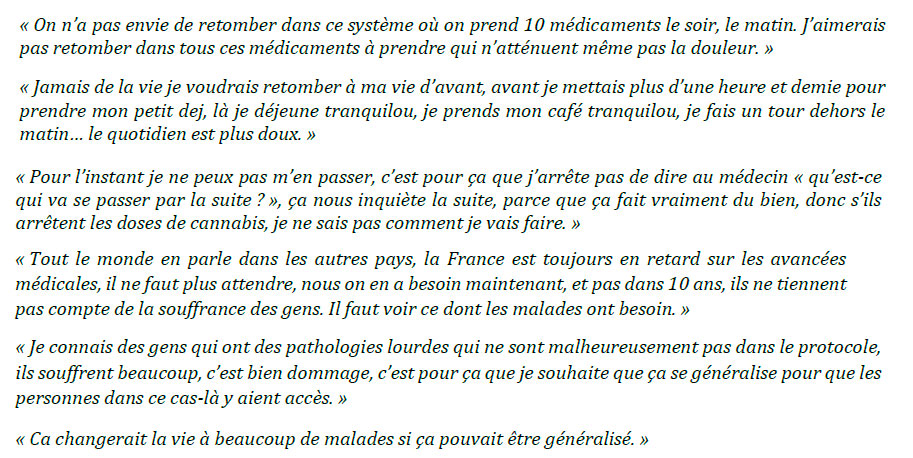
Verbatims from patients included in the trial
In line with previous findings, the majority of respondents interviewed during the qualitative phase - 13 telephone interviews - were in favor of the widespread use of medical cannabis, whether or not treatment had worked for them, according to a «recommendation» principle: «if it can help people who are suffering».
Those for whom the treatment is seen as effective are all the more in favor of the generalization of medical cannabis, and in a very clear-cut way, since this treatment has become essential to their daily lives.
In the event of the experiment being discontinued, if patients could no longer access medical cannabis treatment, some would consider using cannabis illegally.
Finally, feedback notes that «for some patients, medical cannabis is a treatment they can no longer do without, for which there is no alternative, and they are concerned about the future of the experiment».
Why does the Ministry want to extend?
Based on these external reports, the Ministry of Health has drawn up a 13-page final report. Let's jump straight to the conclusions:
- A positive experiment that tends to confirm the feasibility of prescribing and dispensing cannabis for patients (the main objective of the experiment).
- Missing data that the National Health Data System (SNDS) was unable to provide «due to an extremely busy work schedule on many other ministerial priorities».»
- Lack of participation by general practitioners
- Fewer patients enrolled than the imagined 3,000 (editor's note: not an objective to be achieved)
- The lack of work on defining a status for the products used during the experiment and on the terms and conditions of their reimbursement in the event of generalization (ndlr: discussion started in 2018)
If we wanted to show the good faith of the Ministry of Health, we would look at the’amendment presented by the presidential majority to extend the amendment. What is missing, however, is a commitment from the government to legalize medical cannabis on a large scale at the end of the possible postponement.
A number of sources, all of whom wish to remain anonymous, tell us that the Ministry of Health has not made it a priority to make medical cannabis available to French patients, and report various blockages within the Health Department.
Questioned several times, the DGS «will get back to us shortly with an answer».
The Ministry also suddenly forgets to mention that it recently invoked the need to build a French industry and the risk of foreign players gaining a foothold in the market, who today are happy to provide free medical cannabis. What would happen if they refused to continue providing free medical cannabis to 3,000 patients «in active file», as requested by the Ministry?
And finally, why not make this a general practice today, and give all the keys to success to current and future French companies wishing to supply cannabis-based medicines to patients?
A question we put to Santé Cannabis France, which a press release was in favor of extending the experimentation, who did not wish to publish her response in our columns. However, she recently told us that she had been «constantly mobilized alongside patient associations, to ask the French authorities to speed up the definition of the regulatory framework».
In the end, we understand that the Ministry of Health wants to give time to time, even if it means leaving sick people in therapeutic limbo without a solution or, in some cases, buying supplies on the black market.
If France were really looking for data on the efficacy (or inefficacy) of medical cannabis to give itself good reason to legalize it, it could probably turn to other countries that already produce or prescribe medical cannabis on a massive scale: Israel, Canada, Australia, Germany, the Netherlands or 33 states in the USA.





















The Brazilian medical cannabis market continues to grow

Morocco: Three Cannabis-Based Medications Approved for the Treatment of Epilepsy

Canopy Growth Receives New EU-GMP Certification to Strengthen Its Presence in Europe

Three years after legalizing medical cannabis, Albania continues to establish regulations for it

The first plant-based medical THC spray arrives in the United Kingdom

Medical Cannabis in Germany: THC Prices Vary by a Factor of 12

France already has 3,000 cannabis retail outlets. None of them are legal.

Morocco's exports of legal cannabis have expanded to 15 countries

Aurora Cannabis Doubles Its Production Capacity in Germany

Tilray is accelerating its operations in Europe thanks to a license in Portugal
-
 Business2 weeks ago
The legal cannabis market in New York exceeds 4 billion $ in revenue
-

 Cannabis in France4 weeks ago
Which countries legalized medical cannabis before France?
-
Business4 weeks ago
South Korea is preparing to begin local production of medical cannabis to meet rising demand
-
Cannabis in France4 days ago
France already has 3,000 cannabis retail outlets. None of them are legal.
-
Cannabis in Thailand4 weeks ago
From the boom in dispensaries to a purely medical approach: Thailand is revising its cannabis policy
-
Cannabis in the U.S.5 days ago
A DEA report confirms that there are no fatal cannabis overdoses
-
Cannabis and driving3 weeks ago
Medical Cannabis and Driving: New South Wales Ends Automatic Penalties for THC
-
Cannabis in France3 weeks ago
France’s Drug Policy Chief Defends Cannabis Prohibition... and Runs Into the Facts
















You must be logged in to post a comment Login