
Michigan recognizes that THC levels in the blood are not a reliable indicator of driving under the influence

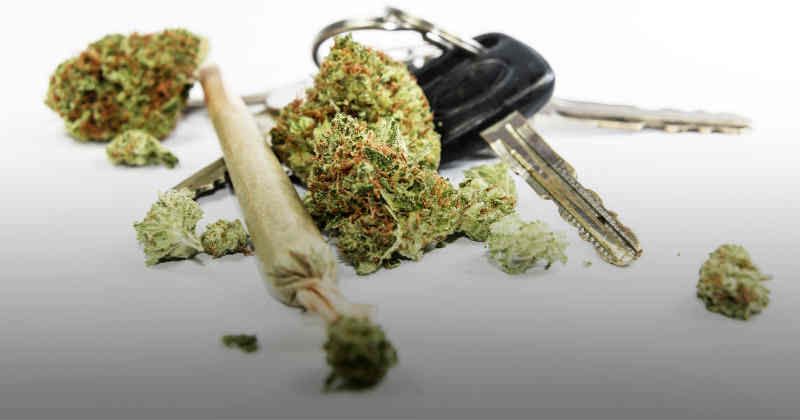
The question cannabis on the roads remains a real headache for countries and states that have legalized it, as well as for those that haven’t. In fact, the tests currently available are unreliable and, more broadly, the effects of cannabis on driving are difficult to assess.
Should they be tested for THC levels in their blood? A Michigan commission tasked with studying the issue does not believe so. In a report released last week, the commission recommended against imposing THC limits in the blood.
Too weak a correlation
After two years of studying the issue, the six members of the’Impaired Driving Safety Committee experts appointed by the state governor concluded that the correlation between blood THC levels and impaired driving was too weak. «Blood THC levels are an indicator of exposure but are not a reliable indicator of an individual’s impaired consciousness,» writes the report. However, this is the standard test used in traffic stops (saliva tests are always confirmed by blood tests).
The commission cites several reasons for this conclusion. First, when cannabis is smoked or vaporized, THC levels rise rapidly and fall just as quickly: they are reduced by half within 10 minutes. This fluctuation is problematic in itself. Second, it is possible to have THC in the blood without being under the influence of cannabis. In fact, THC remains in the bloodstream for about a week after the last use, and in regular users, it can remain in the system for more than a month. THC therefore remains in the blood long after its effects have worn off.
Despite these facts, some U.S. states continue to impose arbitrary blood THC limits. This is the case in Colorado, Washington, Montana, Nevada, and Ohio based on High Times. Under current Michigan law, no level of THC in the blood is permitted, but with the recent legalization of recreational cannabis and the legalization of medical cannabis in 2008, the previous governor decided it was appropriate to address the issue and commissioned this report. It is now up to the legislature to establish new rules regarding driving under the influence in accordance with the report’s recommendations.
By analyzing simulations, the commission also made an interesting discovery: it found that drivers under the influence of cannabis tended to adjust to the subjective effects of the drug. They therefore drive more slowly, maintain safe following distances, and take fewer risks than when they are sober—which is typically not the case for drivers under the influence of alcohol. The latter tend to drive faster, follow more closely, and take more risks than when they are sober. The commission therefore concluded that drivers under the influence of cannabis are less dangerous than those under the influence of alcohol.














CBD: Full-Spectrum Extracts Under Threat in Greece

Medical Cannabis and Back Pain: Opioid Use Has Dropped by 90 % in 10 Years

Cannabis: Wisconsin Could Finally Legalize It in 2027

Argentina Opens Its Market to Hemp Flowers Containing 1% of THC

The French Socialist Party still doesn't know how to approach the legalization of cannabis

Science in the City International: Paris at the Heart of Transatlantic Scientific and Medical Dialogue

Christine Fréchette is alienating Quebec’s cannabis industry

Rima Hassan: When «Drugs» Become a Political Weapon

From Marathons to Ultratrails: How Extreme Running Affects the Endocannabinoid System

Four days of THC may make breast cancer less aggressive, according to a new study
-
 Cannabis and driving2 weeks ago
Cannabis and CBD: French Drivers Can Now Lose Their License Even Without a Positive Test Result
-
Cannabis in France2 weeks ago
Cannabis Legalization: The LFI Bill Has a Major Problem—THC
-

 Cannabis in the Netherlands7 days ago
One year after the launch of the Dutch cannabis experiment, the first trends are emerging
-
Cannabis in France1 week ago
French medical cannabis remains stalled at the Ministry of Health
-
Business7 days ago
The United Kingdom Is Moving Closer to a Regulated CBD Market
-
Cannabis in Argentina4 days ago
Argentina Opens Its Market to Hemp Flowers Containing 1% of THC
-
Cannabis in Europe3 weeks ago
Andorra Paves the Way for Medical Cannabis Cultivation
-
Cannabis in France5 days ago
Rima Hassan: When «Drugs» Become a Political Weapon











You must be logged in to post a comment Login