In South Korea, medical research relies on therapeutic cannabis

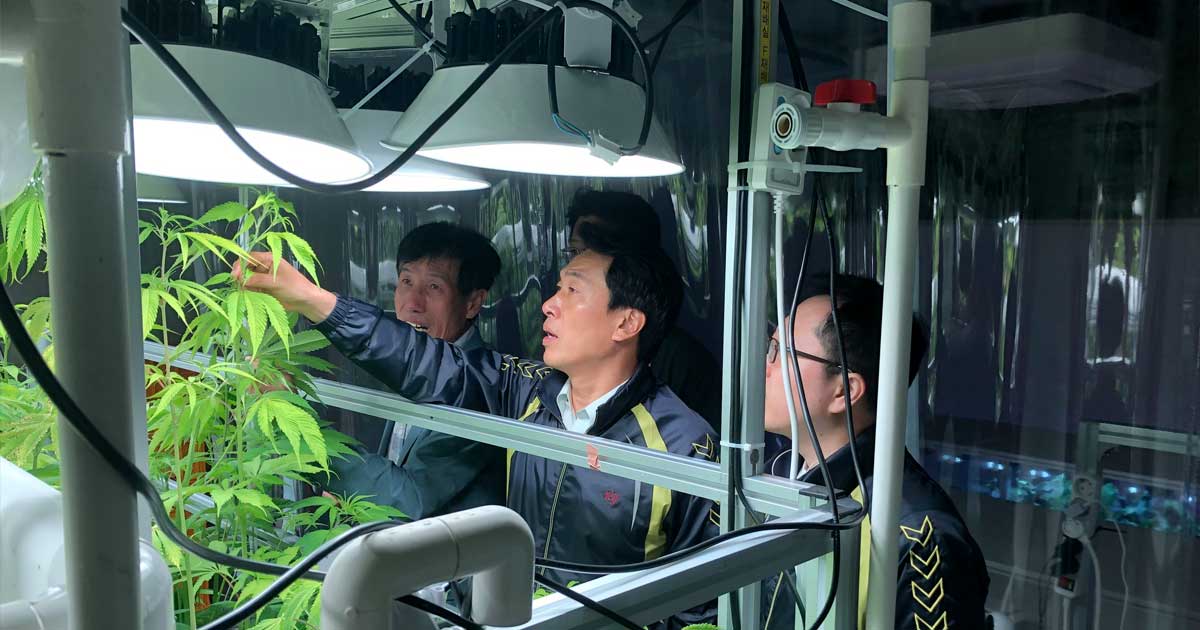
In a country that is still very cautious about the use of cannabis, some research teams in South Korea are multiplying their work around active plant compounds in a strictly medical context. The aim? Advancing research, to lay the foundations for controlled national production and pave the way for new treatments.
High-level scientific research
South Korean researchers have recently identified in the plant of cannabis a new cannabinoid cannabielsoxa, as well as several other compounds never before reported in flowers. This new cannabinoid is said to have inhibitory properties on neuroblastoma cells, a rare but particularly aggressive type of pediatric tumor.
At the same time, the South Korean biotech company NeoCannBio is continuing its work on the cannabidiol (CBD). The company claims to have developed a very high purity CBD extraction technology and is currently conducting preclinical research in association with anticancer treatments.
According to initial results obtained in collaboration with Korea Institute of Science and Technology (KIST), the addition of CBD to certain anti-cancer agents could enhance their therapeutic efficacy.
Strict regulations and a controlled environment
However, South Korea's regulatory environment remains extremely restrictive. The Narcotics Control Act severely limits local cannabis production for medical purposes, hampering industrial and scientific initiatives.
To overcome these obstacles, the government has introduced «regulatory sandboxes», experimental zones where certain restrictions are temporarily lifted. These areas enable companies like NeoCannBio to test the cultivation and processing of medical hemp in a strictly supervised environment, offering a controlled ground for innovation.
Building on this momentum, NeoCannBio is now considering the construction of a GMP (Good Manufacturing Practice) plant in Yeoncheon, Gyeonggi province. The aim is twofold: to secure a national supply of high purity CBD in order to reduce costs, and to develop a export sector to rapidly expanding international markets.
Towards a broader cannabinoid pharmacology
The South Korean study marks a milestone: research is no longer focused solely on the classics. THC and CBD. Identification of minor cannabinoids or completely new, opens the way to new pharmacological perspectives.
Among the 11 compounds isolated from Cannabis flowers, 7 showed significant inhibitory effects on neuroblastoma cells, confirming the therapeutic potential of as yet largely unexplored molecules.
NeoCannBio's ambition is to combining CBD with anti-cancer agents to amplify their effects, a strategy which, if confirmed, could make it possible to incorporate cannabinoids into complex protocols to treat neurological and oncological pathologies. A breakthrough that places South Korea among the most attentive scientific players to the medicinal potential of cannabis compounds.
An up-and-coming sector for health and the economy
The global medical cannabis market, estimated at more than $100 billion by 2032, should constitute a a major segment of the pharmaceutical industry. And South Korea doesn't want to stay on the sidelines.
Especially as South Korean researchers point out that local CBD production could reduce the cost of imported treatments, sometimes estimated at over 30 million won per month. It could also improve access to these products in a controlled therapeutic setting.
But South Korea will have to adapt its legislation. The lack of a framework could slow down the local dynamic, and current laws threaten to deprive the country of an economic windfall in the production and export of medical cannabis.
According to several observers, South Korea already has solid scientific know-how and a growing political will to relax the rules on biotechnology and medical research. To be continued...






















Medical Cannabis in Germany: THC Prices Vary by a Factor of 12

France already has 3,000 cannabis retail outlets. None of them are legal.

Morocco's exports of legal cannabis have expanded to 15 countries

Aurora Cannabis Doubles Its Production Capacity in Germany

Tilray is accelerating its operations in Europe thanks to a license in Portugal

Boston will host the 10th annual State of the Cannabis Industry Conference on October 26

A DEA report confirms that there are no fatal cannabis overdoses

A British patient is challenging the NHS's refusal to reimburse medical cannabis

October 2026 CBD Highlights: 10 Strains and Hash to Discover from 5 French Producers

CBD in France: Traceability, Retail Stores, THC and Driving… What the New Bill Proposes
-
 Business2 weeks ago
The legal cannabis market in New York exceeds 4 billion $ in revenue
-

 Cannabis in France3 weeks ago
Which countries legalized medical cannabis before France?
-
Business3 weeks ago
South Korea is preparing to begin local production of medical cannabis to meet rising demand
-
Cannabis in Thailand3 weeks ago
From the boom in dispensaries to a purely medical approach: Thailand is revising its cannabis policy
-
Cannabis and driving3 weeks ago
Medical Cannabis and Driving: New South Wales Ends Automatic Penalties for THC
-
Cannabis in Argentina4 weeks ago
Argentina Opens Its Market to Hemp Flowers Containing 1% of THC
-
Autism3 weeks ago
Autism and Cannabis: Results from the First Placebo-Controlled Trial of NTI164
-
Cannabis in France2 weeks ago
France’s Drug Policy Chief Defends Cannabis Prohibition... and Runs Into the Facts















cbdtech
9 November 2025 at 11 h 58 min
What do you think of the «regulatory sandboxes» model for unlocking innovation in other countries with strict legislation? Fabien CBDtech