North Macedonia shaken by record seizures of «medical» cannabis»

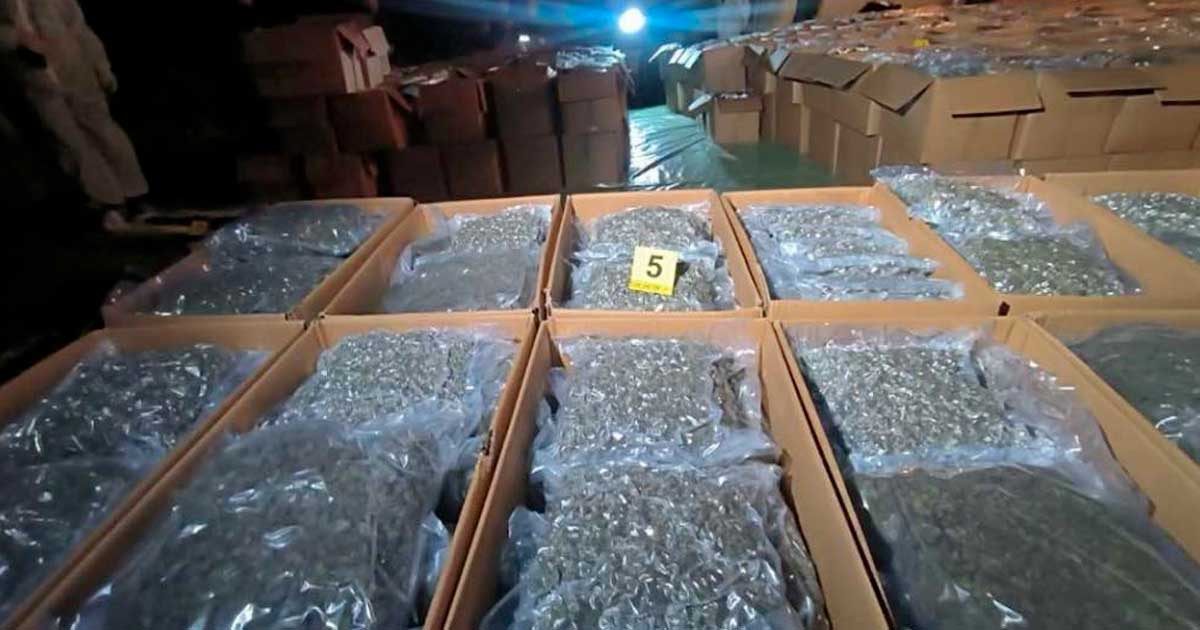
A vast police operation in Northern Macedonia led to the seizure of over 40 tonnes of cannabis and triggered a large-scale inspection of all legal producers.
The investigation was launched after a historic seizure in Serbia where police intercepted five tons of illicit cannabis on January 29, 2026. What began as a national police operation quickly turned into a cross-border investigation, revealing alleged links between Serbian suspects and licensed medical cannabis producers in Northern Macedonia.
A cross-border survey between Serbia and the Northern Macedonia
The Serbian operation took place in the village of Konjuh, near Kruševac, where the authorities confiscated 5,002 kg of cannabis, as well as weapons and cash from a warehouse belonging to the Florakom company, owned by an executive of the ruling SNS and his son.
Serbian prosecutors claimed that the group had purchased the cannabis in North Macedonia before transporting it across the border for distribution. The case immediately raised questions as to whether cannabis legally grown for medical purposes was diverted to illicit trafficking networks.
President Aleksandar Vučić distanced himself from the case, saying, «The police found five tons of a certain drug. Now, whether only the son knew about it or whether both the son and the father knew about it, that's another question; let the competent authorities decide, I don't want to say anything. We carried out this operation.»
The scale of the seizure has revived memories of the Jovanjica affair, a Serbian case that is still highly publicized, involving the industrial cultivation of hemp, allegedly masking large-scale illegal cannabis production.
Over 40 tonnes seized from licensed companies
A week after the arrests in Serbia, the North Macedonian authorities launched coordinated raids in several regions, including Skopje and the agricultural center of Strumica.
According to the Ministry of the Interior, around nine tonnes of cannabis flowers and 1,300 bottles of cannabis oil were seized from a company near Skopje. A further 31 tonnes of cannabis flowers and biomass for oil production were confiscated in the east of the country.
Interior Minister Panče Toshkovski said, «The cannabis was produced, stored and kept outside established protocols, which means it was handled illegally by the companies from which it was seized.»
Investigators reported significant discrepancies between officially recorded production volumes and quantities physically observed during inspections. Although the companies concerned held licenses to grow and process cannabis for pharmaceutical purposes, the authorities suspect that significant quantities may have been diverted from legal supply chains.
Prime Minister Hristijan Mickoski said, «There is no compromise with injustice and illegality, and no one is above the law.» He added that the total volume seized could increase further as inspections continue.
Spotlight on Alphapharm and regulatory loopholes
Particular attention was paid to Alphapharm DOO Skopje, a licensed producer established in 2023 and granted cultivation authorization in April 2024. One of the Serbian suspects is said to be co-owner of the company.
Changes in ownership within the company were recorded shortly after the Serbian seizure, further intensifying suspicions. Macedonian prosecutors have confirmed their close cooperation with Serbian authorities to determine whether the cannabis intercepted in Serbia originated from licensed facilities in Northern Macedonia.
Police inspections revealed irregularities, including discrepancies between the quantities of cannabis declared and the actual quantities on site. As a result, the authorities confiscated all the equipment found on the company's premises.
This case has raised broader questions about transparency. Although over 60 licenses have been granted since legalization, no comprehensive public list of licensed companies is readily available. Investigations by local media have highlighted the absence of clear public control mechanisms in this sector.
A legal framework under pressure since 2016
The Northern Macedonia legalizes cannabis cultivation for medical purposes in 2016, positioning itself as a potential regional hub for pharmaceutical production. Cannabis oil has been promoted primarily for cancer, HIV and epilepsy patients, under strict state supervision.
Since the law came into force, the authorities have issued around a hundred licences. According to the Department of Health, 43 companies currently hold active licenses, while 14 have lost their licenses over the years due to infractions.
In 2025 alone, several companies were prosecuted for production irregularities, leading to further seizures and confiscation of plants.
Health Minister Azir Aliu announced that inspections were underway at the 43 licensed producers. «Exceptional circumstances call for exceptional measures. That's why I have requested legislative amendments to create several monitoring committees where necessary. The checks start today, and we expect clear monthly reports from all the bodies involved. Transparency is not optional.»
Two commissions, one within the Ministry of Health and the other interministerial, oversee the review process.
Political implications for the EU
The affair quickly slipped into the political arena. The ruling VMRO-DPMNE party called for investigations into possible links between certain cannabis licenses and figures close to the Social Democrats, including former Prime Minister Zoran Zaev. The opposition, for its part, points to a major security flaw: how could five tons of cannabis have crossed the Serbian border undetected?
Beyond the exchange of accusations, the stakes are institutional. As a candidate for membership of the European Union, North Macedonia is expected to demonstrate its ability to effectively control a sensitive sector such as medical cannabis, guarantee the traceability of production and uphold the rule of law.
Massive seizures also undermine the country's economic credibility. The development of pharmaceutical cannabis was presented as a lever for exports. From now on, the priority for the authorities will be to reassure investors and international partners of the soundness of controls and compliance with manufacturing standards.

















Medical Cannabis in Germany: THC Prices Vary by a Factor of 12

France already has 3,000 cannabis retail outlets. None of them are legal.

Morocco's exports of legal cannabis have expanded to 15 countries

Aurora Cannabis Doubles Its Production Capacity in Germany

Tilray is accelerating its operations in Europe thanks to a license in Portugal

Boston will host the 10th annual State of the Cannabis Industry Conference on October 26

A DEA report confirms that there are no fatal cannabis overdoses

A British patient is challenging the NHS's refusal to reimburse medical cannabis

October 2026 CBD Highlights: 10 Strains and Hash to Discover from 5 French Producers

CBD in France: Traceability, Retail Stores, THC and Driving… What the New Bill Proposes
-
 Business2 weeks ago
The legal cannabis market in New York exceeds 4 billion $ in revenue
-

 Cannabis in France3 weeks ago
Which countries legalized medical cannabis before France?
-
Business3 weeks ago
South Korea is preparing to begin local production of medical cannabis to meet rising demand
-
Cannabis in Thailand3 weeks ago
From the boom in dispensaries to a purely medical approach: Thailand is revising its cannabis policy
-
Cannabis and driving3 weeks ago
Medical Cannabis and Driving: New South Wales Ends Automatic Penalties for THC
-
Cannabis in Argentina4 weeks ago
Argentina Opens Its Market to Hemp Flowers Containing 1% of THC
-
Autism3 weeks ago
Autism and Cannabis: Results from the First Placebo-Controlled Trial of NTI164
-
Cannabis in France2 weeks ago
France’s Drug Policy Chief Defends Cannabis Prohibition... and Runs Into the Facts

















You must be logged in to post a comment Login