
Jamaica Eases Small Farmers' Access to the Cannabis Market


Jamaica is continuing its efforts to integrate small-scale growers into its legal cannabis market. Six years after launching initiatives designed to facilitate traditional producers’ entry into the regulated sector, the country is taking another step forward with two new measures aimed at reducing the financial and administrative barriers that remain.
Driven by the Cannabis Licensing Authority (CLA), the Jamaican licensing authority, this reform introduces, among other things, specific permits, technical support, and opportunities for collective cultivation. It is part of a broader revision of national regulations, with one goal: to expand legal production while preventing long-standing growers of ganja remain outside the regulated market.
An issue that is by no means new
The issue of integrating small-scale producers is not a new one in Jamaica. As soon as 2020, the The government was already seeking to facilitate their entry on the legal market, particularly through the program Alternative Development Program (ADP). The program was intended to help farmers from communities traditionally involved in cannabis production transition to the regulated system.
The new measures announced in 2026 thus continue a policy that has been in place for several years, but seek to address the remaining challenges more directly: the cost of licenses, technical requirements, necessary investments, and administrative complexity.
Two New Licenses for Jamaican Farmers
The reform, reported by High Times, is based primarily on two mechanisms: the Cultivator’s Transitional Special Permit, intended for individual farmers, and the Special Community Permit, designed for producers who want to form a group.
The first one offers small farmers a two-year transition period to grow their business and gradually meet the standards required for a traditional license. During this period, they can receive technical support from the CLA and sell their products on the legal market.
To be eligible, you must, among other things, be at least 18 years old and reside in Jamaica and have access to at least half an acre of land, or approximately 2,000 m². However, you do not have to be the owner: a lease or written permission from the landowner may be sufficient.
Ultimately, the goal is to help these growers obtain at least one Level 1 cultivation license.
«This also reduces the financial barriers for participants, who will have access to our technical team, will be able to sell ganja within the authorized area, and—I repeat—this permit is free,» said Farrah Blake, Executive Director of the CLA.
According to Jamaican authorities, no application or permit fees are required under this transitional arrangement.
Up to 4 hectares for community projects
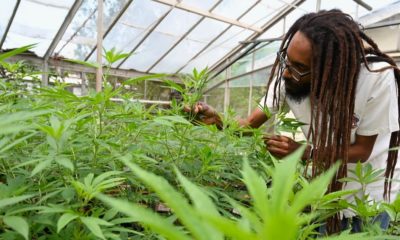
The Special Community Permit is based on a collective approach. Several traditional farmers can come together to form a registered entity, pool their resources, and farm together up to 4 hectares of cannabis.
Once again, the CLA does not charge any licensing fees. The groups in question also have access to technical support and can sell their products through the regulated distribution channel.
This approach seeks to address one of the major obstacles faced by small-scale producers in Jamaica. Expenses related to security, infrastructure, administrative procedures, and compliance can represent an investment that is difficult for a small farm to afford.
During a tour organized by the CLA in September, Shandel Hannam, the authority’s head of operations, summarized the goal: «These permits were created to allow people who may not necessarily have the means to obtain standard licenses to enter the industry.»
Bringing in new producers also meets a market need. According to the CLA, About 70% of the industry's players are retailers. The number of certified growers therefore remains relatively low compared to the number of retail outlets that need to be supplied.
Cultivation licenses are now valid for three years
The new licenses are part of a broader reform of the Jamaican regulations on medical cannabis.
Crop cultivation licenses, which were previously valid for one year, are now issued for three years, just like the other categories of permits. This change is intended to streamline the renewal process and provide operators with greater clarity.
Other measures were also adopted: standardizing the height of fences required on farms to six feet, introducing professional ID cards for employees in the sector, and allowing authorized retailers to deliver to their customers.
However, the creation of these permits does not resolve all the difficulties faced by traditional producers. Maurice Ellis, president of the Ganja Growers and Producers Association of Jamaica, believes, in particular, that farmers still need simplified procedures, financial and technical support, and concrete opportunities to bring their crops into the legal market.
With this reform, the Jamaica is thus attempting to resolve one of the paradoxes of its industry: building a market for the cannabis regulated and economically viable without excluding the small-scale producers who have shaped the cultivation of this plant on the island for generations.



















Jamaica Eases Small Farmers' Access to the Cannabis Market

Faced with resistance from Aurora, Curaleaf raises its offer by 25%

Massachusetts: 71.1% of voters want to keep cannabis legal

All Our Tips for Finding a Reliable CBD Store

Uncertainty surrounding Bedrocan threatens the supply of medical cannabis flowers to Danish patients

"Light" Cannabis in Italy: The ban on hemp flowers will be delayed until February 2027 pending a ruling by the Constitutional Court

The legal cannabis market in New York exceeds 4 billion $ in revenue

France’s Drug Policy Chief Defends Cannabis Prohibition... and Runs Into the Facts

Cannabis and the Adolescent Brain: French Scientists Make a Key Discovery

EFSA Gives Initial Approval for Synthetic CBD; Natural Extracts Still Pending
-
 Cannabis and driving4 weeks ago
Cannabis and CBD: French Drivers Can Now Lose Their License Even Without a Positive Test Result
-

 Cannabis in France2 weeks ago
Which countries legalized medical cannabis before France?
-
Cannabis in France4 weeks ago
Cannabis Legalization: The LFI Bill Has a Major Problem—THC
-
Business2 weeks ago
South Korea is preparing to begin local production of medical cannabis to meet rising demand
-
Cannabis in the Netherlands3 weeks ago
One year after the launch of the Dutch cannabis experiment, the first trends are emerging
-
Cannabis in Thailand2 weeks ago
From the boom in dispensaries to a purely medical approach: Thailand is revising its cannabis policy
-
Cannabis in Argentina3 weeks ago
Argentina Opens Its Market to Hemp Flowers Containing 1% of THC
-
Cannabis in France3 weeks ago
French medical cannabis remains stalled at the Ministry of Health















You must be logged in to post a comment Login