
Aden Holloway, young American basketball hopeful, arrested for possession of cannabis in Alabama

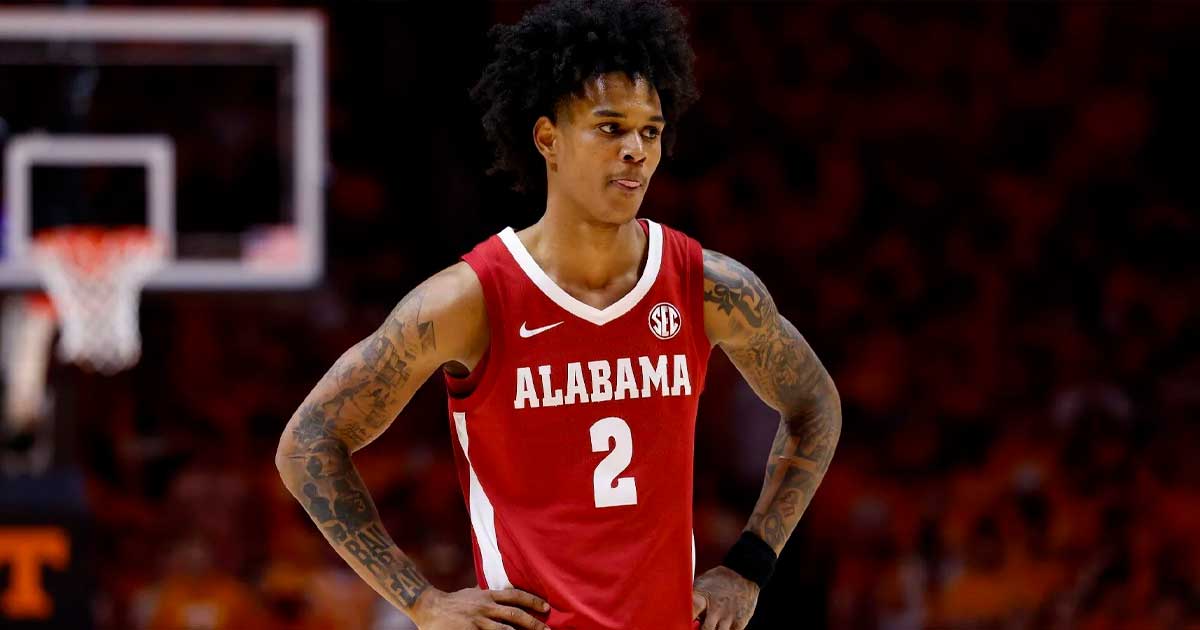
The recent arrest of’Aden Holloway once again highlights the significant legal disparities surrounding cannabis in the United States, where regulations can vary considerably from state to state.
The 21-year-old point guard from the’Alabama Crimson Tide was arrested in Tuscaloosa after authorities discovered approximately 950 grams of cannabis in his apartment, an amount slightly below the 1-kilogram threshold that would have resulted in a trafficking charge under the Alabama law.
Holloway is accused of first-degree possession of cannabis for non-personal use, an offense classified as Class C felony. This violation is subject to severe penalties, which can include 10 years in prison and a a $15,000 fine. He was also charged with failing to affix a revenue stamp and released on $5,000 bail.
A career threatened by a state-level offense
Beyond the immediate consequences, this incident could ruin Holloway’s future. A key player on the Alabama team and potential NBA prospect, he was suspended indefinitely from the team while the NCAA Tournament is in full swing.
His attorney, Jason Neff, insists there is no evidence of trafficking. «He has no criminal record,» Neff said. «If he pleads guilty or even goes to trial, the judge could place him on probation. This is a crime. For a 21-year-old trying to finish college and make it to the NBA, a criminal record could be a major long-term obstacle.»
In another document, the defense took a firm stance: «The defendant denies each of the factual allegations and demands irrefutable evidence in this regard. The defendant hereby requests a trial regarding the allegations made by the plaintiff.»
The legal proceedings could last up to 18 months, creating prolonged uncertainty for both the player and his professional career.
Cannabis Legislation in the United States: A Fragmented Landscape
While Holloway's situation is serious in light of the Alabama's prohibition framework, she would likely be treated very differently in other parts of the country. Twenty-five states have now legalized cannabis for adult use, often allowing individuals to legally possess several ounces. In those jurisdictions, a case involving personal possession could result in minimal penalties, or none at all, depending on the circumstances.
Alabama remains one of the most restrictive states. Recreational cannabis is completely illegal there, and even minor offenses can result in criminal prosecution. Although limited medical use has been authorized In recent years, access has remained strictly controlled and has not been extended to the general public.
If the authorities had found even a little more, the charges could have been significantly more serious, exposing him to even harsher penalties. This type of rigid threshold system is common in states where cannabis is illegal, where weight-based distinctions determine whether a case is treated as personal possession or as organized distribution.
For athletes and public figures, the risks are magnified. A single arrest in a state where cannabis is illegal can end a career, even though similar behavior is perfectly acceptable elsewhere in the country. The In fact, the NBA no longer tests for cannabis among its players.


















Medical Cannabis: 14 Organizations Finally Call for Enforcement of the Law

One year after the launch of the Dutch cannabis experiment, the first trends are emerging

High Ground: The Crash of a Plane Full of Marijuana That Made History in Yosemite

The United Kingdom Is Moving Closer to a Regulated CBD Market

Mexico's Supreme Court Authorizes Cannabis-Infused Edibles for Personal Use

French medical cannabis remains stalled at the Ministry of Health

Things are heating up between Sherbinski and Doja

Cookies Ordered to Pay $61.5 Million in a Dispute with Its Investors

Frenchfarm is launching its B1G1 clearance sale + free gift

Czech Republic: CBD shops selling synthetic cannabinoids are in the police's crosshairs
-
 Cannabis and driving6 days ago
Cannabis and CBD: French Drivers Can Now Lose Their License Even Without a Positive Test Result
-
Cannabis in France1 week ago
Cannabis Legalization: The LFI Bill Has a Major Problem—THC
-
Cannabis in Europe2 weeks ago
Andorra Paves the Way for Medical Cannabis Cultivation
-
Cannabis in France2 weeks ago
Drought: Could Hemp Become the New Hope for French Farmers?
-

 Cannabis in the Netherlands17 hours ago
One year after the launch of the Dutch cannabis experiment, the first trends are emerging
-
Business20 hours ago
The United Kingdom Is Moving Closer to a Regulated CBD Market
-
Cannabis in France2 days ago
French medical cannabis remains stalled at the Ministry of Health
-
Cannabinoids2 weeks ago
What if CBD enhanced the effects of THC? A comprehensive analysis challenges a common misconception









You must be logged in to post a comment Login