The Bulldog celebrates 50 years!

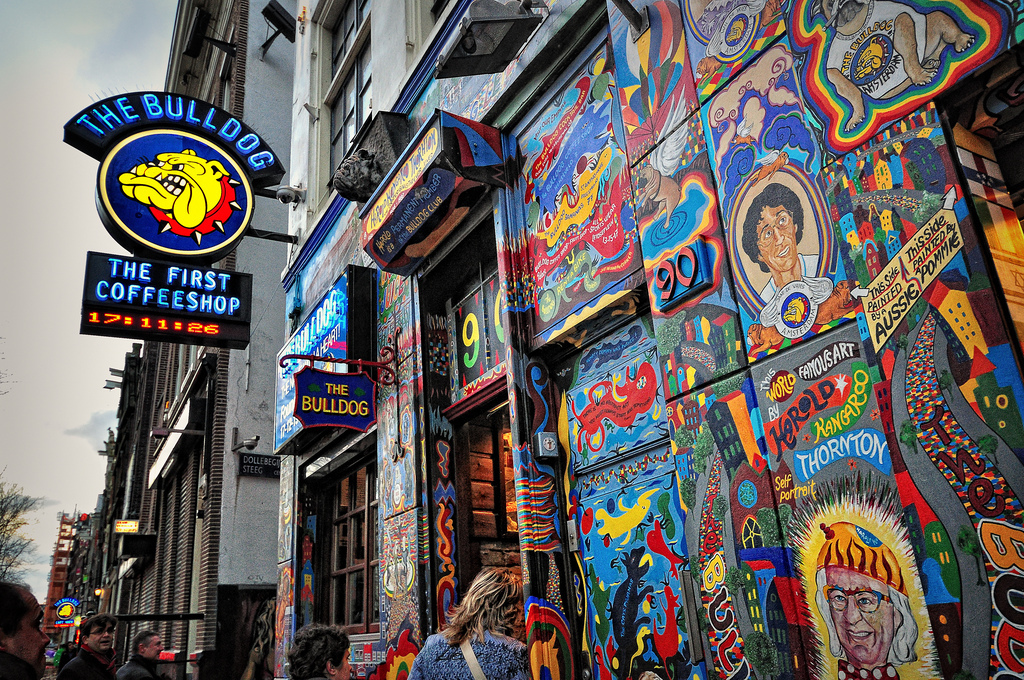
Visit 1975, at 90 Oudezijds Voorburgwal, a small basement in the red-light district of Amsterdam quietly became the epicenter of a global cultural shift. Fifty years on, The Bulldog is no longer just a coffeeshop It's a symbol, a brand and a point of reference in the history of the cannabis cultivation. Its anniversary is an opportunity to look back at how one address helped shape a typically Dutch approach to tolerance, entrepreneurship and urban living.
From Zeedijk to cultural monument
The history of Bulldog is inseparable from that of its founder, Henk de Vries, a child from the Zeedijk. Long before the coffee shop existed, the neighborhood was already known for its intensity: sailors, sex workers, small businesses and informal economies coexisted in a dense urban ecosystem. De Vries grew up there and never left.
«I'm still proud and happy to be a boy from the Cedijk,» he recalls, describing a rough but deeply social neighborhood where everyone knew each other and where helping each other was a necessity rather than a slogan.
This context would later inspire the Bulldog's philosophy: neither a club nor a store, but what de Vries still calls «the Amsterdam salon».
1975: the birth of the first Bulldog
The transformation began when de Vries inherited the property from his father in n° 90 Oudezijds Voorburgwal, which housed a cinema and a sex shop. Uncomfortable with the business and the compromises it demanded, he made a radical decision. According to his own account, he took the remaining stock and threw it into the canal, declaring, «I don't want to make a living like this.»
Inspired by his past experiences and informal gatherings around cannabis, he decided to open a space where people could consume and buy cannabis openly. At November 1975, the Bulldog n° 90 officially opened its doors.
The idea was simple but revolutionary: to sell cannabis over the counter, with no secrets, no backroom. «This is our living room. We're just going to do our own thing with cannabis here,» de Vries said of the debut.
In the 1970s, Amsterdam was far from the regulated model we see today. The sale of cannabis was neither legal nor tolerated and The Bulldog quickly became a focal point for law enforcement. Police raids were constant, sometimes several times a day. Customers were fined, products confiscated and staff regularly searched.
Yet the coffee shop survived thanks to improvisation and community loyalty. Warning systems, hiding places and a remarkable customer culture turned repression into resilience. De Vries recalls that customers would often return shortly after raids, fines in hand, ready to sit down again.
These confrontations helped shape what would later become the gedoogbeleid Dutch policy of tolerance, which the separation between cannabis and harder substances. For de Vries, this line of demarcation has always been non-negotiable: «I'm someone who loves cannabis... but anything beyond that is out of the question.»
A unique meeting place
What really set us apart The Bulldog No.90, It wasn't just what he sold, but also the people who passed through his doors. Locals, tourists, sex workers, civil servants, artists and drug dealers all found themselves in the same space. De Vries recalls moments that seemed impossible elsewhere: «Ten minutes later, for example, another prostitute came in... she came into the basement and also smoked a joint.»
This social mix was at the heart of the coffeeshop's identity. In a neglected neighborhood, it offered security, warmth and neutrality. As de Vries puts it, it was «the first place of rest, the safe refuge in a desert on the Voorburgwal».
The coffee shop's visual identity also played a crucial role in its success. The psychedelic mural painted by Harold Thornton, also known as Harold Kangaroo, transformed the building into a landmark long before cannabis tourism became a concept. Bright colors, bold graphics and the now iconic bulldog logo made n°90 instantly recognizable.
This visibility was no accident. In a city characterized by hidden courtyards and narrow streets, The Bulldog refused to be discreet. He saw himself as an integral part of the street, the history of the neighborhood and Amsterdam's image abroad.
From basement to global brand
Fifty years later, The Bulldog Amsterdam has expanded far beyond its original basement. Coffeeshops, bars, hotels, merchandising and The Bulldog Seeds now bear his name all over the world. Yet de Vries insists that this expansion was never driven by abstract ambition. «I only started businesses where I felt comfortable as a person,» he explains, describing locations chosen out of personal affinity rather than pure strategy.
Despite its scale, the brand's history of origins continues to shape its ethos: independence, refusal of criminal alliances and distance from institutional finance. De Vries notes that he never had access to traditional banking services, a reminder that being a pioneer often comes at a personal cost.
«What I'm most proud of are my children».», he says anyway, before acknowledging the wider impact of what began in that basement. A place where people from all walks of life sat together, respected boundaries and shared a moment of calm.
Half a century later, The Bulldog remains what it was in its early days: a mirror of Amsterdam's contradictions and a reminder that cultural change sometimes starts with nothing more than a room, a joint and a refusal to do things the old-fashioned way.


















«Vincy Gold»: Humboldt Seed Company on the Hunt for Saint Vincent Sativas

Cronos Completes the Acquisition of CanAdelaar for 57.5 million euros

Cannabis with a "bloody" twist: Discover Sensi True Blood and Sensi Sangria, the two new strains from Sensi Seeds

Hemp: The Council of the EU Takes a Stand on New Production and Marketing Rules

Missouri's legal cannabis market accounts for 93 % of consumer spending

THC Gummies: How to Read a Certificate of Analysis Before Buying

British patients now have access to THCV-rich cannabis flowers

Spain: Medical Cannabis Is Coming to About 50 Hospitals

JIHE 2026: Japan’s Largest Trade Show Dedicated to Hemp and CBD Returns to Tokyo with More Than 100 Industry Players

New Caledonia: The Courts Clear the Way for the Return of CBD
-
 Business3 weeks ago
The legal cannabis market in New York exceeds 4 billion $ in revenue
-

 Cannabis in France4 weeks ago
Which countries legalized medical cannabis before France?
-
Cannabis in France1 week ago
France already has 3,000 cannabis retail outlets. None of them are legal.
-
Business4 weeks ago
South Korea is preparing to begin local production of medical cannabis to meet rising demand
-
Cannabis in the U.S.1 week ago
A DEA report confirms that there are no fatal cannabis overdoses
-
Cannabis in Thailand4 weeks ago
From the boom in dispensaries to a purely medical approach: Thailand is revising its cannabis policy
-
Cannabis and driving4 weeks ago
Medical Cannabis and Driving: New South Wales Ends Automatic Penalties for THC
-
Cannabis in France3 weeks ago
France’s Drug Policy Chief Defends Cannabis Prohibition... and Runs Into the Facts
















You must be logged in to post a comment Login