Can you smoke weed in space?

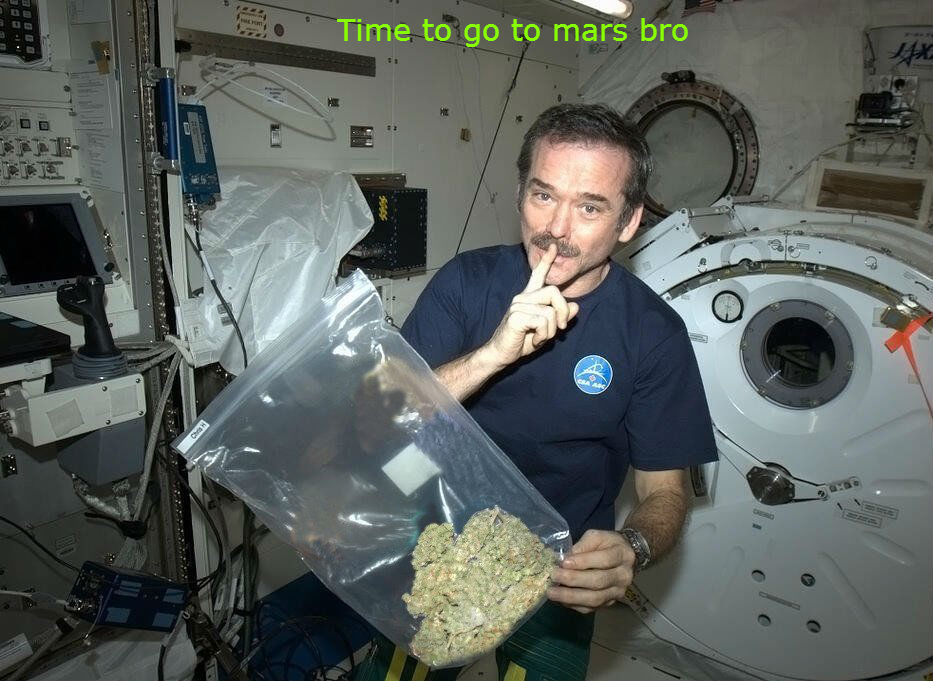
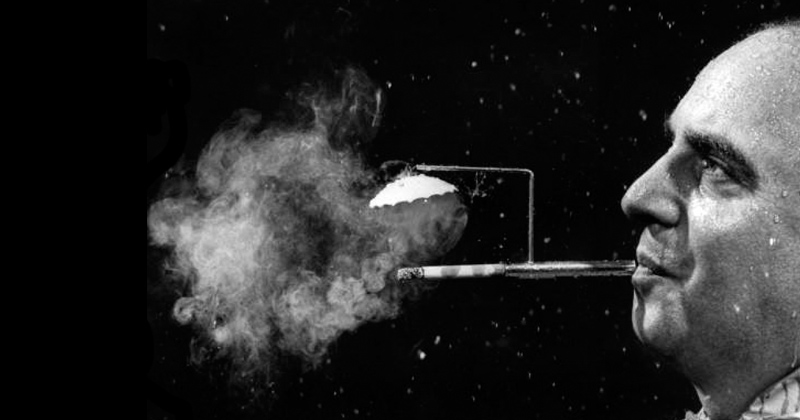
Picture the scene. Tucked away in the International Space Station, Thomas Pesquet rolls a little buzz and starts making smoke rings. Little green men start knocking on the door, asking to spin the oinj. Science fiction? Completely. But the question is asked. Can you smoke cannabis in space?
Apart from the fact that this would require a light combustion in a human-sized tin can perched in orbit at 400 kilometers, or a good spray, it seems difficult. Researchers at the University of California suggest that cosmic rays passing through space could simply annihilate the psychoactive effects of cannabis. From the point of view of a future human conquest of space, the space joint would be a utopian fantasy.
American and Hungarian scientists have shown that the endocannabinoid system could be disrupted by the energy-charged protons that make up cosmic rays. It's hard to see a cosmonaut farting his joint, but according to Bruce Goldman, «this issue could be important in the next 50 years». Research by Professor Sang-Hun Lee of the University of California explains how space travel affects the brain, and how humans stay healthy without a solar cycle. «Before sending humans on long-term missions into space, we need to know the long-term risks of exposure to cosmic rays.
Cosmic rays composed of highly charged protons emitted by the Sun are deflected in large quantities by the Earth and its atmosphere. This protection does not exist in space. In this study, the researchers focus on the effect of these protons on the hippocampus, the part of the brain where memory and the notion of space are concentrated.
In particular, they found that cosmic rays interfere with the functioning of endocannabinoid receptors. In experiments on mice, the researchers found that energetically-charged protons influence the nervous system. In an irradiated mouse, the CB1 receptors release large amounts of y-aminobutyric acid, known as GABA. These GABAs are neurotransmitters that reduce the levels of 2 AG, the natural endocannabinoid partly responsible for the ’high" in the brain.’homeostasis (regulation of the human body's essential functions).
To put it simply: cosmic rays disrupt the endocannabinoid system and may alter the psychoactive effects of THC.
The researchers also found, via a battery of tests, that the neuronal structure of the mice was altered. Visit discovery and problem-solving skills were clearly diminished. Disruption of the mice's hippocampus continued for several months after irradiation ended.
Smoking weed in these conditions would simply be a waste. NASA, on the other hand, is working on cosmic ray shields, which could allow THC to be assimilated by the human body, even in space.
So, for the time being, smoking is totally banned on board the ISS.
This highly important research was published in Brain Structure and Function.








Medical Cannabis in Germany: THC Prices Vary by a Factor of 12

France already has 3,000 cannabis retail outlets. None of them are legal.

Morocco's exports of legal cannabis have expanded to 15 countries

Aurora Cannabis Doubles Its Production Capacity in Germany

Tilray is accelerating its operations in Europe thanks to a license in Portugal

Boston will host the 10th annual State of the Cannabis Industry Conference on October 26

A DEA report confirms that there are no fatal cannabis overdoses

A British patient is challenging the NHS's refusal to reimburse medical cannabis

October 2026 CBD Highlights: 10 Strains and Hash to Discover from 5 French Producers

CBD in France: Traceability, Retail Stores, THC and Driving… What the New Bill Proposes
-
 Business2 weeks ago
The legal cannabis market in New York exceeds 4 billion $ in revenue
-

 Cannabis in France3 weeks ago
Which countries legalized medical cannabis before France?
-
Business3 weeks ago
South Korea is preparing to begin local production of medical cannabis to meet rising demand
-
Cannabis in Thailand3 weeks ago
From the boom in dispensaries to a purely medical approach: Thailand is revising its cannabis policy
-
Cannabis and driving3 weeks ago
Medical Cannabis and Driving: New South Wales Ends Automatic Penalties for THC
-
Cannabis in Argentina4 weeks ago
Argentina Opens Its Market to Hemp Flowers Containing 1% of THC
-
Autism3 weeks ago
Autism and Cannabis: Results from the First Placebo-Controlled Trial of NTI164
-
Cannabis in France2 weeks ago
France’s Drug Policy Chief Defends Cannabis Prohibition... and Runs Into the Facts
















seb
January 5, 2017 at 21 h 02 min
I think it's IMPORTANT to point out that this photo is a montage ... to be sure I did the research several months ago when I saw it circulating on the networks.
seb
January 5, 2017 at 21 h 09 min
google: Canadian astronaut Chris Hadfield eggs
Evrard Lancrey
May 16, 2017 at 11 h 55 min
The space station doesn't exist: http://www.mensonges.fr/ISSS/ISS.html
NewsWeed
May 16, 2017 at 12 h 05 min
Neither does cannabis.