IDPC presents 20 principles for regulating cannabis markets

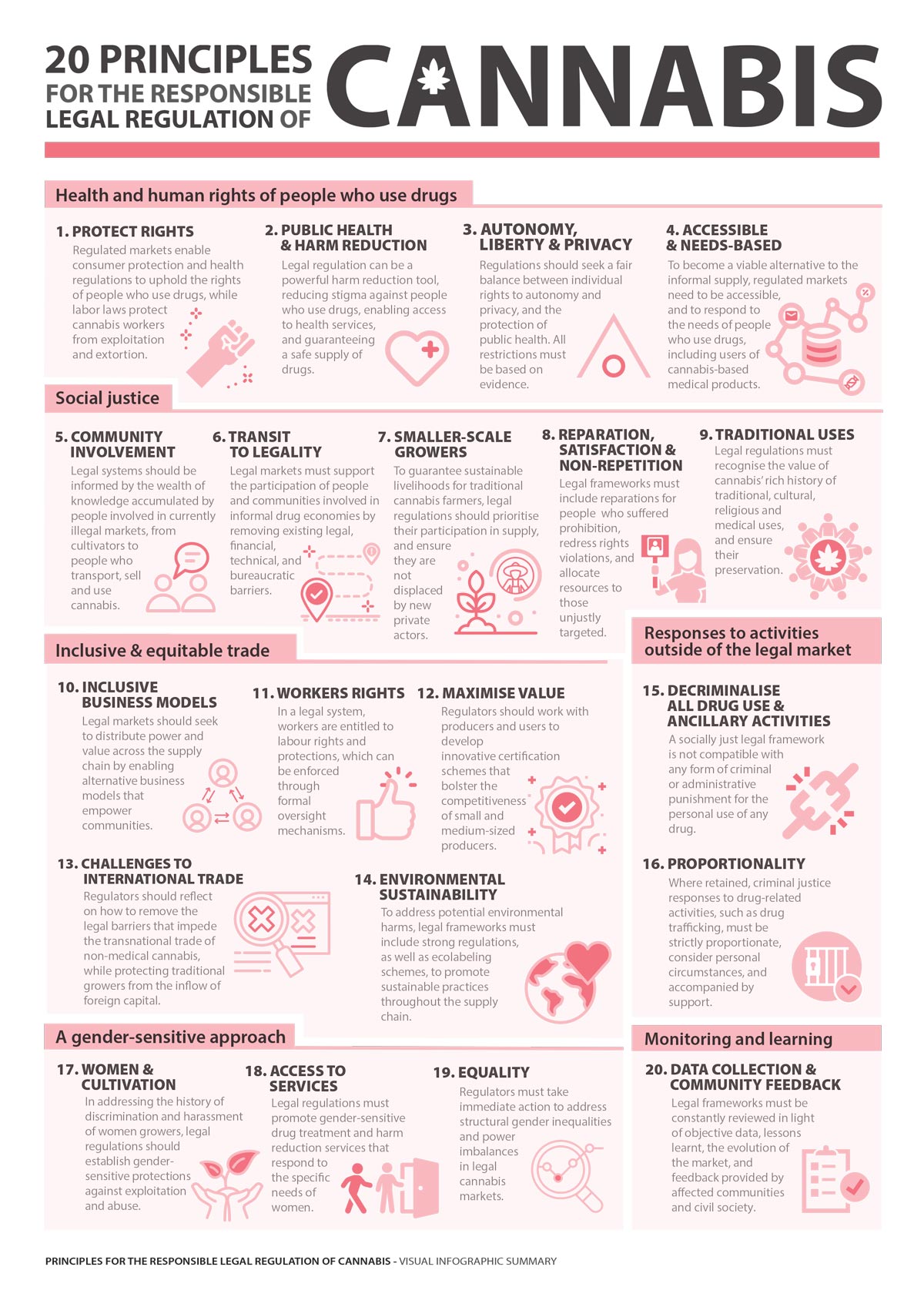
In a document published at the beginning of September, the International Drug Policy Consortium (IDPC) presents twenty principles to guide responsible regulation of drug markets. cannabis.
As the consortium reminds us in its introductory note, more than 50 countries have now «adopted regulatory frameworks for medical cannabis, while a growing number of jurisdictions have regulated adult non-medical use, and many more are poised to follow. As these legal frameworks are put in place, it is essential that they are designed to advance social justice, inclusion and human rights.»
It sees regulation as a powerful tool to «remedy decades of criminalization, economic exclusion and lack of access to appropriate health care» and «repair the damage caused by the «war on drugs»». Poor regulation, on the other hand, can, according to IDPC, further criminalize those who remain outside regulated markets.
The IDPC sets out 6 main pillars for responsible cannabis regulation:
- legal markets should protecting health and human rights people who use drugs, by providing them with full access to health services and with the full range of rights and protections usually accorded to consumers on the legal markets.
- legal markets must advancing social justice seeking to redress the harms of punitive policies and ensuring that the communities most affected by prohibition, who in many cases have been oppressed on the basis of race, gender identity or sexual orientation, are able to make the transition to the legal market - if they so wish
- regulatory frameworks should promote business models and international trade policies that advance economic inclusion, sustainable development and climate justice in local, regional and global supply chains
- legal reforms must remove penalties for personal drug use and ancillary activities, including for substances or activities not covered by regulated markets. While sanctions are always imposed for traffic-related activities, punitive responses must be strictly proportionate and accompanied by other interventions.
- legal regulations must adopt a gender-sensitive approach, to remedy the disproportionate prejudice and exclusion suffered by women under ban.
- the new regulatory frameworks should include mechanisms for comprehensive data collection, analysis and dissemination on drug markets and consumption, as legal regulation is an ongoing, iterative process that responds to market developments and lessons learned.
The full report can be consulted online here (in English) and the 20 principles have been brought together in the infographic below.
























JIHE 2026: Japan’s Largest Trade Show Dedicated to Hemp and CBD Returns to Tokyo with More Than 100 Industry Players
New Caledonia: The Courts Clear the Way for the Return of CBD

The Brazilian medical cannabis market continues to grow

Morocco: Three Cannabis-Based Medications Approved for the Treatment of Epilepsy

Canopy Growth Receives New EU-GMP Certification to Strengthen Its Presence in Europe

Three years after legalizing medical cannabis, Albania continues to establish regulations for it

The first plant-based medical THC spray arrives in the United Kingdom

Medical Cannabis in Germany: THC Prices Vary by a Factor of 12

France already has 3,000 cannabis retail outlets. None of them are legal.

Morocco's exports of legal cannabis have expanded to 15 countries
-
 Business2 weeks ago
The legal cannabis market in New York exceeds 4 billion $ in revenue
-

 Cannabis in France4 weeks ago
Which countries legalized medical cannabis before France?
-
Business4 weeks ago
South Korea is preparing to begin local production of medical cannabis to meet rising demand
-
Cannabis in France4 days ago
France already has 3,000 cannabis retail outlets. None of them are legal.
-
Cannabis in Thailand4 weeks ago
From the boom in dispensaries to a purely medical approach: Thailand is revising its cannabis policy
-
Cannabis in the U.S.5 days ago
A DEA report confirms that there are no fatal cannabis overdoses
-
Cannabis and driving3 weeks ago
Medical Cannabis and Driving: New South Wales Ends Automatic Penalties for THC
-
Cannabis in France3 weeks ago
France’s Drug Policy Chief Defends Cannabis Prohibition... and Runs Into the Facts

















You must be logged in to post a comment Login