Grinder: How to Choose the Right Model for Your Herbs, Tobacco, or CBD Flowers


People often pick out a grinder at random—at a booth or at the checkout—and make do with it until the day the lid gets stuck, the blades stop cutting, and you have to finish the job with your fingers. Yet, just three or four criteria are enough to avoid picking a bad one. Here are the ones that really matter.
Aluminum, steel, wood, or acrylic: the material comes first
L’Aluminum remains the standard, and for good reason. It’s lightweight, it can withstand drops, and—when machined properly—the lid turns smoothly without catching. The catch lies in the entry-level models: on poorly finished aluminum, the teeth rub against each other and can leave tiny metal shavings in the grounds. If the threads start to scratch right from the start, that’s a bad sign.
L’stainless steel It’s in a league of its own. Heavier and more expensive, it’s virtually scratch-resistant and can withstand alcohol wipes without batting an eye. It’s the kind of thing you’d keep at home rather than in your pocket.
The The wood has a certain charm, but it has its limitations. It can't be washed with water, it absorbs odors, and its ’teeth"—often metal prongs embedded in the material—sometimes end up becoming loose. The’acrylic, on the other hand, is a good stopgap: it costs almost nothing, but its plastic teeth get dull or break quickly. Before Choosing a Grinder, so it's best to know whether it will be stored on a shelf or in a backpack.
Two, three, or four sections: what each floor offers
The two parts, this is the basic model: a lid and a chamber, both with teeth. You grind, open it, and collect the grounds directly between the teeth. It’s compact and quick to clean, but not always convenient to empty neatly.
The three parts Adds a compartment beneath the grinding chamber. This compartment has holes in it: the ground grass falls through and waits to be used. You no longer have to scrape it out from between your teeth.
The four parts takes it a step further with a fine mesh filter beneath the collection compartment. The finest particles—pollen—pass through and accumulate in a tray at the bottom. Most of these models come with a small spatula for removing the pollen. This is the most comprehensive model, but it’s also the tallest and takes the longest to clean.
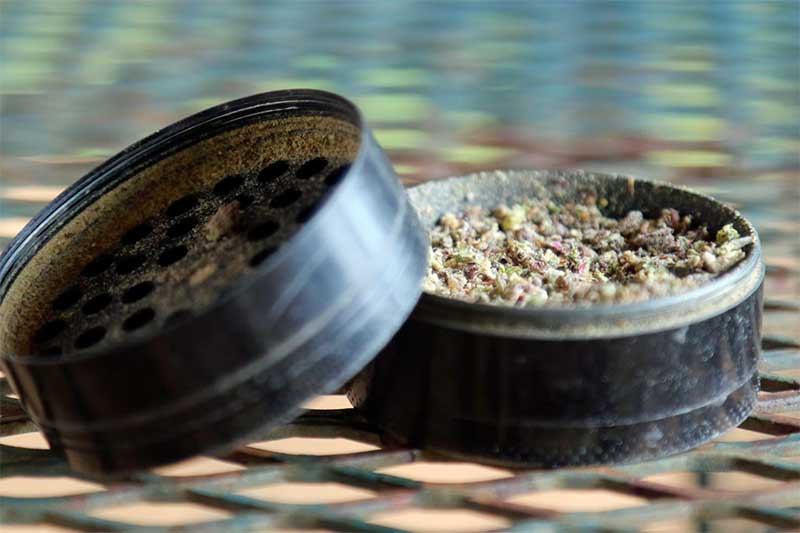
Choosing the Right Grinder
Diameter and Teeth
A small-diameter one slips into a jeans pocket and goes unnoticed. For a one-time use, it’s more than enough. As soon as you’re preparing larger quantities, you have to do it in several rounds, and its poor grip tires out your wrist when working with slightly sticky flowers. A larger diameter provides more leverage, but it takes up more space.
Also look at the shape of the teeth. The diamond-shaped teeth, when properly sharpened, cut through the coffee and produce a light, airy grind. Round burrs or those that are too widely spaced crush rather than cut, resulting in a denser grind. A good test to try in the store: spin the grinder with no coffee in it. It should spin smoothly, and the lid should stay in place—often thanks to a magnet.
Care: A Few Tips to Extend Its Lifespan
Over time, resin builds up on the teeth and threads, the screen gets clogged, and the lid becomes difficult to close. A quick brush with a dry brush after a few uses prevents most of these problems. A tip known to regular users: put the grinder in the freezer for 15 minutes before brushing it; the resin hardens and comes off more easily.
For thorough cleaning, the metal models can be taken apart and soaked in’isopropyl alcohol, then rinse and air-dry. Wood and acrylic do not hold up well to this treatment: a brush and a toothpick are still the best option. All methods are detailed in this cleaning guide.
Ultimately, the main question is where the grinder will be used and how much time you’re willing to spend maintaining it. A well-made, four-piece aluminum grinder covers most uses. Other materials cater to more specific needs.









Grinder: How to Choose the Right Model for Your Herbs, Tobacco, or CBD Flowers

Thanksgiving: The «Cousin Walk,» an American cannabis tradition that’s coming out of the shadows

Medical Cannabis in France: Stéphanie Rist Postpones Regulatory Changes Until January 2027

Germany: Pharmacists Propose a Pilot Program to Sell Recreational Cannabis in Pharmacies

France Is More Reluctant to Legalize Cannabis Than the EU Average, According to a New EUDA Survey

Scientists Create Cannabinoid-Free Hemp

MediPharm is preparing to launch its cannabis inhaler in Europe

Sensi Seeds and High Times are teaming up to launch five new cannabis strains

Brains Bioceutical is aiming for the Nasdaq with a valuation of $750 million

CBD in French Polynesia: Sublingual Oils Soon to Be Available Over the Counter
-
 Cannabis in Quebec4 weeks ago
Cannabis: What France Could Learn from Quebec, Eight Years After Legalization
-
Cannabis in New Zealand4 weeks ago
Chronic Pain: New Zealand Is Testing Cannabis to Improve Sleep
-
Cannabis in France4 weeks ago
Dr. Pascal Douek, a tireless advocate for medical cannabis in France, has died
-
Cannabis in France4 weeks ago
Medical cannabis: The Greens introduce two amendments to accelerate its widespread adoption
-
Cannabis in Canada4 weeks ago
A Canadian study reveals the pleasant psychotropic effects of high-dose CBD
-
Studies on cannabis4 weeks ago
More THC, barely any additional effects: A new study challenges common assumptions about the potency of cannabis
-
Cannabis in Argentina4 weeks ago
The Argentine province of Chubut is creating its own framework for medical cannabis
-
Cannabis in France3 weeks ago
Medical Cannabis: Patients Issue a Formal Notice to the Government to Break the Deadlock

















You must be logged in to post a comment Login