
What was said during the April 17, 2019 CSST on medical cannabis?

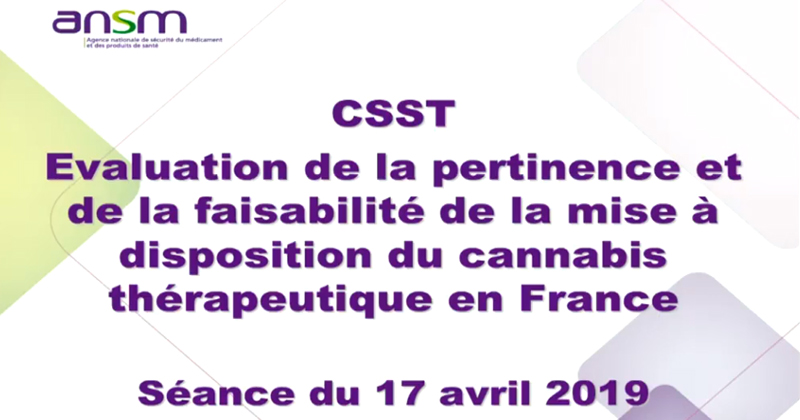
While some all Game of Thrones episodes to rank them from worst to best, we have chosen to review the ANSM's CSST of April 17, which is continuing its hearings with a view to setting up a regulatory system for medical cannabis in France.
The Temporary Specialized Scientific Committee (CSST) began its work in October 2018, then concluded late last year of the need to give French patients access to medical cannabis in the form of the plant and products derived from the plant, conclusion repeated in part by the Agence Nationale de Sécurité du Médicament (ANSM) et des Produits de Santé, then by Prime Minister Edouard Philippe during his visit to Creuse in March.
The session on April 17 was attended by a number of learned societies, with feedback from foreign examples of regulation to present patient needs, forms of administration and possible dosages.
Summary of 7 hours of video (including 1h30 lunch break).
Learned societies received
- The French Society for the Study and Treatment of Pain (SFETD), start here
- La Société Française d'Accompagnement et de soins Palliatifs (SFAP), start here
- The French Federation of Physical and Rehabilitation Medicine, start here
- The College of General Medicine, start here
- The National Council of the Order of Physicians, start here
- The French Neurology Society, start here
- La Société Francophone de la Sclérose En Plaques, start here
- The French Society of Clinical Pharmacy, start here
- The French Society of Officinal Pharmaceutical Sciences, start here
- Conseil national de l'ordre des pharmaciens, start here
Examples from abroad
- Bedrocan, Europe's leading producer of medical cannabis, start here
- The Cannabisagentur Germany, start here
- L’Israeli Medical Cannabis Agency, start here
Important clarifications
In its conclusions, The CSST spoke of «experimentation with medical cannabis», without giving any details of the experimentation.
Nathalie Richard from ANSM made it clear that the experimentation would not be used to validate the benefit/risk of medical cannabis, which had already been done at CSST PART 1. The experiment will be an effective implementation of medical cannabis. In PART 2 (currently in progress), the CSST will set out the terms and conditions for prescribing and distributing therapeutic cannabis, as well as monitoring.
Medical cannabis should have the status of a medicine, in the form of a preparation or pharmaceutical speciality, without marketing authorization.
In a nutshell
All learned societies are in favor of dispensing medical cannabis to French patients. Most of them report that their patients already use cannabis, either with a prescription and purchase of the drug abroad, or by buying cannabis on the black market or by self-cultivation.
With regard to prescribing, discussions are moving towards a secure 28-day prescription, which already exists for other narcotics. The vast majority of learned societies are in favor of a prescription by a specialist, which could be renewed by GPs once the treatment has stabilized, with the exception of GPs who are open to a prescription at home.
The need for training for medical teams, doctors and nurses, pharmacists and dispensing chemists has been raised many times, both compulsory and voluntary, through e-learning or physical training.
Cannabis could be prescribed as a third-line treatment, on a par with opiates, for pathologies resistant to traditional treatments.
The pathologies concerned have already been announced but are not definitive:
- in pain refractory to accessible therapies (drug or non-drug)
- in certain forms of severe, drug-resistant epilepsy
- as part of supportive care in oncology
- in palliative situations
- in the painful spasticity of multiple sclerosis. In the latter case, this could open up to spasticity as a whole, without being linked to multiple sclerosis or pain.
Foreign examples show that prescriptions are made by general practitioners, whether trained or not, and not necessarily limited to specific pathologies. In Israel, all doctors can prescribe but must have the prescription validated by a trained physician, of whom there are 180 today, and as many more in training (training lasts 40 hours). In Germany, the choice of medical cannabis is left to the doctor in the case of treatment-resistant pathologies. In the Netherlands, prescribing is left to the doctor's discretion, if he or she feels that cannabis can be of benefit to the patient.
With regard to forms of administration, the need for different cannabinoid ratios (particularly CBD/THC) and stable dosages was reiterated. The 1:1 ratio seems to be the best tolerated, with Bedrocan pointing out that its most prescribed product is the 22% THC -1% CBD variety. The importance of choice for patients was noted, enabling them to find what suits them best.
The possibility was raised of having fast-acting forms (like dried flowers in vaporized form, with approved vaporizers) and slower-acting forms (like oils, in sublingual or capsule form). Access to Sativex was also requested. If medical cannabis were to arrive in pharmacies in oil form, we'd have products without clinical trials on prescription and a pharmaceutical product that is not dispensed, in this case Sativex, an «ubiquitous» situation according to Eric Thouvenot of the SFSEP.
On the distribution side, each side argues its own case. Hospital specialists are in favor of hospital delivery, while community pharmacists are in favor of pharmacy delivery.
In terms of follow-up, an anonymized patient registry could be set up to collect data on treatment efficacy, in particular to compensate for the lack of clinical studies on the human use of cannabis in large, representative cohorts. Patients should also have regular appointments with their doctors to give feedback on their treatment and adapt it if necessary.
The need for research was also raised on several occasions. ANSM pointed out that research is already possible, but the supply of non-synthetic compounds remains difficult.
Unanswered questions
Several questions were asked, either by the members of the SSTC or by the interviewees:
- What about driving for sick people? Should there be a recommendation not to drive, or a ban?
- NWD thought: how will patients get their medication if it's only dispensed in hospital pharmacies, sometimes with a 1-hour drive, if they can't drive? Possibility of a medical card and a higher THC limit for cardholders.
- Calling it «cannabis» could annoy pharmacy customers, as well as confusing it with «street» cannabis.»
- NWD thought: there's always the possibility of naming products, like Bedrocan varieties.
- What is covered by health insurance?
- Which production circuit? This question should be addressed during the next May session of the CSST.











Christine Fréchette is alienating Quebec’s cannabis industry

Rima Hassan: When «Drugs» Become a Political Weapon

From Marathons to Ultratrails: How Extreme Running Affects the Endocannabinoid System

Four days of THC may make breast cancer less aggressive, according to a new study

Medical Cannabis: 14 Organizations Finally Call for Enforcement of the Law

One year after the launch of the Dutch cannabis experiment, the first trends are emerging

High Ground: The Crash of a Plane Full of Marijuana That Made History in Yosemite

The United Kingdom Is Moving Closer to a Regulated CBD Market

Mexico's Supreme Court Authorizes Cannabis-Infused Edibles for Personal Use

French medical cannabis remains stalled at the Ministry of Health
-
 Cannabis and driving7 days ago
Cannabis and CBD: French Drivers Can Now Lose Their License Even Without a Positive Test Result
-
Cannabis in France1 week ago
Cannabis Legalization: The LFI Bill Has a Major Problem—THC
-

 Cannabis in the Netherlands2 days ago
One year after the launch of the Dutch cannabis experiment, the first trends are emerging
-
Cannabis in Europe2 weeks ago
Andorra Paves the Way for Medical Cannabis Cultivation
-
Business2 days ago
The United Kingdom Is Moving Closer to a Regulated CBD Market
-
Cannabis in France3 days ago
French medical cannabis remains stalled at the Ministry of Health
-
Cannabis in France2 weeks ago
Drought: Could Hemp Become the New Hope for French Farmers?
-
Cannabis in the U.S.2 weeks ago
United States: Congress Rejects Ban on THC Derived from Hemp












You must be logged in to post a comment Login