Ban on cannabis and khat overturned in Uganda

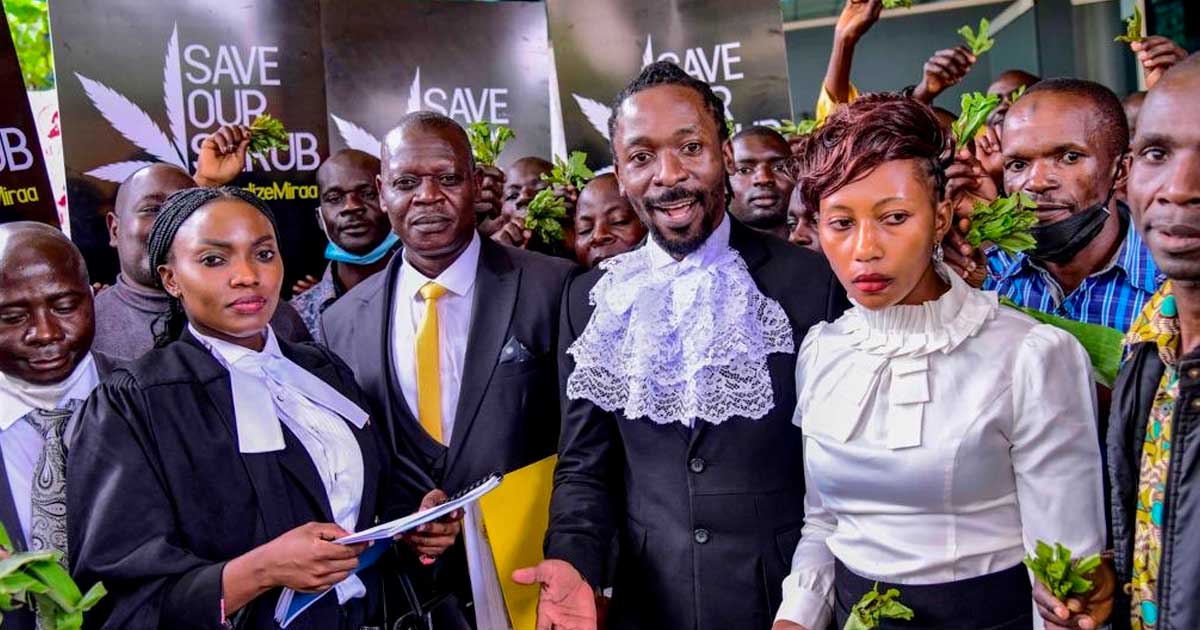
Uganda's Constitutional Court has struck down a law criminalizing drugs and narcotics, such as cannabis and khat.
This decision follows a lawsuit filed six years ago by a group of khat growers in response to the 2015 law, the Narcotic Drugs and Psychotropic Substances (Control) Act, which was repealed in its entirety after the Court ruled that it had been adopted without the required quorum in Parliament.
For a law to be debated and passed by the Ugandan parliament, at least one third of all voting members must be present in the chamber. Even if the law has been annulled, there is still a risk of arrest for the cultivation, possession, consumption or sale of drugs prohibited or restricted under other Ugandan laws.
Read more: Uganda approves the cultivation of medical cannabis
Farmers against the State
In the 2017 petition, Ugandan farmers, under the aegis of their umbrella organization, Wakiso Miraa Growers and Dealers Association, have asked the Constitutional Court to annul the law passed by the country's parliament, which they claim does not comply with the principles of legality, equality, rationality and proportionality guaranteed by the Constitution, since they were never consulted.
The growers also argued that they were adversely affected by the way the law seeks to prohibit the cultivation, possession, consumption, sale, purchase, storage, distribution, sale of transport, This decision was not supported by any evidence, scientific or otherwise.
Last Friday, Uganda's Constitutional Court, represented by a panel of five judges, ruled that the way the law had been promulgated was illegal and that the only solution was to repeal it.
«At the voting stage, the bill must receive a sufficient number of votes to be legally adopted. The sufficient number of votes is prescribed by Article 89, paragraph 1, of the Constitution. It is the majority quorum.
The judges of the Constitutional Court therefore consider that any bill passed without the above-mentioned procedure having been followed is null and void.
«I have already established that, according to the evidence presented to the Court, the Speaker of Parliament did not verify the quorum required by Rule 23(3) of the Rules of Procedure of the 9th Legislature, 2012. I have also found that the evidence before the court supports the petitioners» contention that there was no quorum at the time of the passage of the bill for the enactment of the law," ruled Justice Kibeedi.
Repeal of the law
In repealing the whole Act, Justice Kibeedi held that since the provisions prohibiting the trade in miraa, the local name for khat, had not been dealt with by Parliament independently of the rest of the provisions of the Narcotic Drugs and Psychotropic Substances (Control) Act 2015, the whole Act must be struck down.
«As such, there is nothing to save in the challenged law,» he ruled, before annulling the law and awarding costs to the petitioner.
Commenting on the ruling, Kizito Vincent, chairman of the petitioners, hailed the development as a great victory.
«This is a great victory for a Ugandan farmer who sells miraa. Previously, our members had been arrested, their businesses destroyed and many others had lost their property. Following the enactment of the law, our businesses were paralyzed because we could no longer export and sell freely, even though we have enough scientific research to prove that miraa is not dangerous», said Mr. Kizito.
«Our research shows that miraa is both a food and a medicine. Many of our members have been able to educate children and build homes through the sale and trade of miraa, but the government didn't take this into account when it drafted this law.»
He declared that he was ready to work with the government to ensure the rationalization of his business.
However, according to legal experts, the repeal of the current law means that the previous law, the National Drug Policy and Authority Act, remains in place to fill the void.













Medical Cannabis in Germany: THC Prices Vary by a Factor of 12

France already has 3,000 cannabis retail outlets. None of them are legal.

Morocco's exports of legal cannabis have expanded to 15 countries

Aurora Cannabis Doubles Its Production Capacity in Germany

Tilray is accelerating its operations in Europe thanks to a license in Portugal

Boston will host the 10th annual State of the Cannabis Industry Conference on October 26

A DEA report confirms that there are no fatal cannabis overdoses

A British patient is challenging the NHS's refusal to reimburse medical cannabis

October 2026 CBD Highlights: 10 Strains and Hash to Discover from 5 French Producers

CBD in France: Traceability, Retail Stores, THC and Driving… What the New Bill Proposes
-
 Business2 weeks ago
The legal cannabis market in New York exceeds 4 billion $ in revenue
-

 Cannabis in France3 weeks ago
Which countries legalized medical cannabis before France?
-
Business3 weeks ago
South Korea is preparing to begin local production of medical cannabis to meet rising demand
-
Cannabis in Thailand3 weeks ago
From the boom in dispensaries to a purely medical approach: Thailand is revising its cannabis policy
-
Cannabis and driving3 weeks ago
Medical Cannabis and Driving: New South Wales Ends Automatic Penalties for THC
-
Autism3 weeks ago
Autism and Cannabis: Results from the First Placebo-Controlled Trial of NTI164
-
Cannabis in France2 weeks ago
France’s Drug Policy Chief Defends Cannabis Prohibition... and Runs Into the Facts
-
CBD1 week ago
In Brazil, researchers are developing an innovative CBD eye drop

















You must be logged in to post a comment Login