Canadians' perception of cannabis has changed little in 2021

Canadians are about the same on most issues related to cannabis, its use and legalization as they were in 2020, according to Canada's latest annual report.
The 'Canadian Cannabis Survey 2021″ is the fifth of its kind, the first having been published at the end of 2017. The survey asks a sample of Canadians a number of questions about cannabis, such as their knowledge and opinions about cannabis use and cannabis laws, knowledge of legal sources, cannabis and driving, cannabis and pregnancy, cannabis use and cultivation at home, and the cannabis for medical purposes among many other topics.
Stable acceptability
Canadians consider cannabis consumption to present the second lowest perceived risk, behind alcohol, but a healthier choice than using tobacco or nicotine. Occasional cannabis use is also considered more socially acceptable than regular alcohol use. Smoking and eating cannabis is considered slightly more socially acceptable than vaping cannabis. Tobacco and e-cigarettes present the lowest level of social acceptability among these three broad categories.
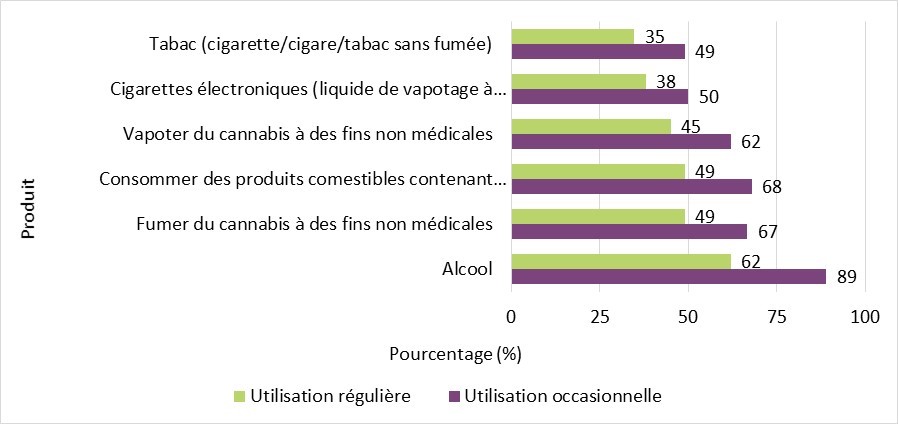
Social acceptability of the use of various products, among all Canadians, 2021
Overall, 89% of those surveyed believe that cannabis use can be addictive. The majority (93%) of those who said they had used cannabis in the last 12 months believe that cannabis can be addictive. A majority (88 %) of those who have not used cannabis also believe that cannabis can be addictive.
Consumption down slightly
25% of Canadians say they have tried cannabis in the past 12 months, down slightly from 27% in 2020. Men were once again more likely to use cannabis than women, but self-reported use by men declined slightly, as did self-reported use by Canadians aged 16 to 24.
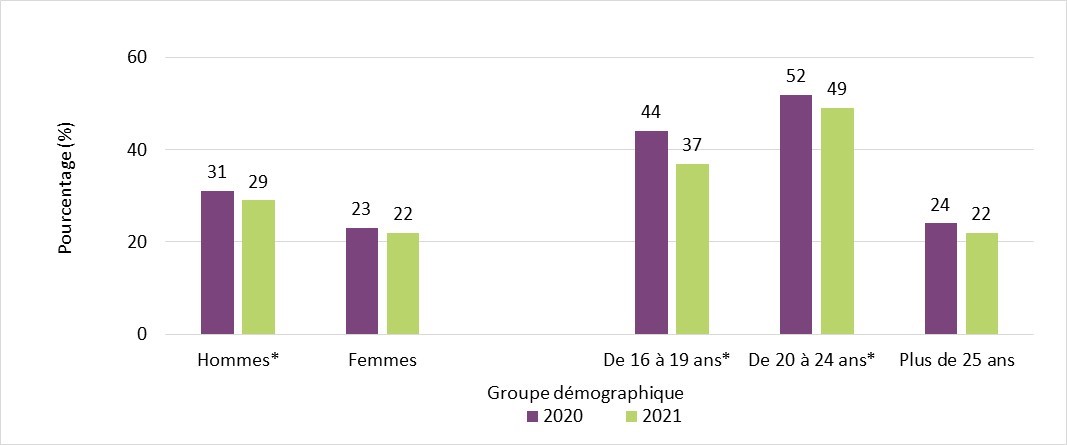
Cannabis use in the past 12 months, by gender and age group, 2020 to 2021
14% of Canadians aged 16 and over also reported having used cannabis for medical purposes, but only 22% of them said they had done so with the authorization of a health professional.
People born in Canada are about twice as likely to use cannabis as those who emigrated here, and use is approximately 2 times higher among self-identified homosexuals, or «other sexuality» than those who identify as heterosexual.
Those enrolled in school are more likely (35 %) to report using than those not enrolled in school (25%). People who report having worked at a job or business in the past week, or having taken a vacation, are slightly more likely to use cannabis than those not working at a job or business (28% vs. 21%).
Canadians with post-graduate degrees are less likely to use cannabis than those without, 17% vs. 24%.
Among those who declared using more cannabis due to the COVID-19 pandemic, Canadians under 25 reported a greater increase in consumption.
25% of those aged 25 and over reported using more cannabis, compared with 46% of those aged 16 to 19 and 40% of those aged 20 to 24. At the same time, 21% of those aged 25 and over reported using less cannabis, compared with 27% of those aged 16 to 19 and 25% of those aged 20 to 24.
Once again, most Canadians who use cannabis say they use it less than one day a month - 33% of users - while 19% say they use it daily. 27% reported using from one to six days a week.
Most cannabis users (72%) said they were stone or high for between one and four hours a day, while 15% said they were stoned for five hours or more a day when using.
All these figures are identical or similar to those for 2020.
Later experimentation
The age of cannabis initiation has also continued to rise slightly since legalization. In a 2017 survey, the average age of first introduction to cannabis was 18.6. By 2020, it was 20, and by 2021 it was 20.4.
Cannabis is legal in different provinces at different ages: 18, 19 or 21.
Smoking remains the most common form of consumption (74%), although this is down from 79% in 2020, while vaping has increased from 24% in 2020 to 28% in 2021. The edibles cannabis were the second most popular form of consumption, at 54%. Those who reported drinking cannabis doubled from 2020, from 7% to 15%. 22% reported using cannabis oil or capsules, a new figure in 2021.
Among those who vaporize cannabis, vaporization of cannabis extracts increased from 60% to 68%, that of dried cannabis flower decreased from 65% to 54%.
Men were slightly more likely than women to use cannabis flower or concentrates, while women were slightly more likely to use edibles and topicals.
The legal market outstrips the illegal one
58% of Canadians who said they used cannabis said they would be more willing to disclose publicly if they did, compared with 51% in 2020.
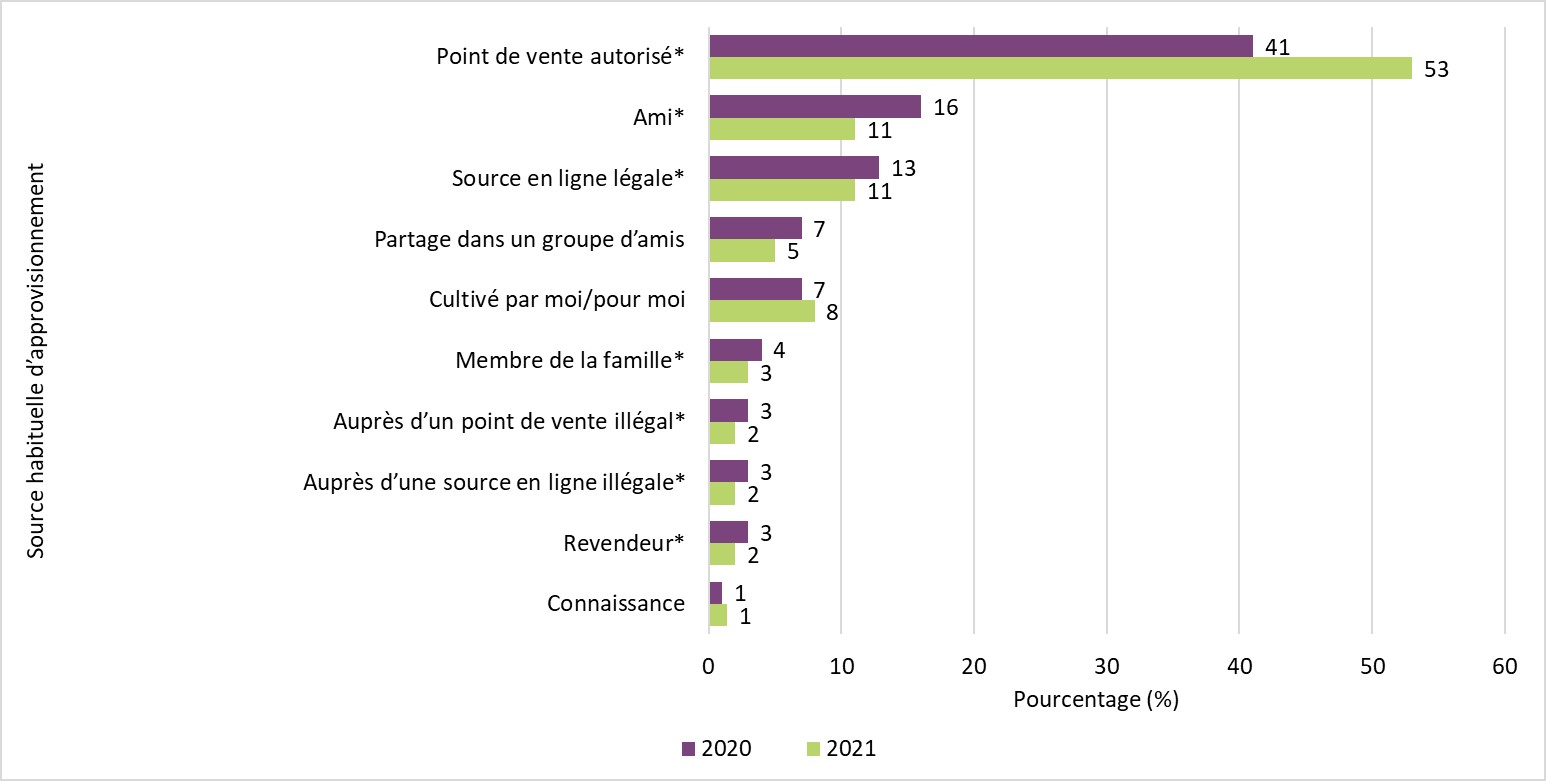
Usual sources of supply in the past 12 months for people who have used cannabis in the past 12 months, from 2020 to 2021
53% reported making a purchase from a legal store, up from 41% in 2020. People were less likely to obtain cannabis from a friend or legal online source, or from an illegal store or online source or «dealer».
Of those who said they used cannabis, 43% said they only sourced it from the legal market, up from 37 % in 2020. 63% said they never used an illicit source, compared with 55% in 2020.
A higher percentage (43%) indicated that they always source from a legal/authorized source in 2021 than in 2020 (37%). There was also a higher percentage (63%) indicating that they never source from an illegal/unauthorized source in 2021 than in 2020 (55%).
Of those who buy from the illicit market, most (59%) say they get it from someone they know, while 20% say they get it from an illicit online store. 20% also claim to obtain cannabis from a «dealer». Only 11% say they get it from an unlicensed retail store, although it's possible that this figure is higher as some consumers have the impression that illicit stores are in fact legally operated.
The average consumer spends between 40 and 100$ CA per month on cannabis.
Among consumers who reported using cannabis for medical purposes, those who reported obtaining it from legal stores increased from 44% in 2020 to 53% in 2021, and those who obtained it from a legal online source increased from 23% to 38%.
A further 21% sourced from a licensed producer through the medical system. 13% said they grew it or had it grown for them under a designated production license, as in 2020.
Of those who have obtained cannabis directly from a licensed producer, 77% say they intend to continue doing so even if non-medical cannabis stores are available.
The complete study is available on the Health Canada website.






















Medical Cannabis in Germany: THC Prices Vary by a Factor of 12

France already has 3,000 cannabis retail outlets. None of them are legal.

Morocco's exports of legal cannabis have expanded to 15 countries

Aurora Cannabis Doubles Its Production Capacity in Germany

Tilray is accelerating its operations in Europe thanks to a license in Portugal

Boston will host the 10th annual State of the Cannabis Industry Conference on October 26

A DEA report confirms that there are no fatal cannabis overdoses

A British patient is challenging the NHS's refusal to reimburse medical cannabis

October 2026 CBD Highlights: 10 Strains and Hash to Discover from 5 French Producers

CBD in France: Traceability, Retail Stores, THC and Driving… What the New Bill Proposes
-
 Business2 weeks ago
The legal cannabis market in New York exceeds 4 billion $ in revenue
-

 Cannabis in France3 weeks ago
Which countries legalized medical cannabis before France?
-
Business3 weeks ago
South Korea is preparing to begin local production of medical cannabis to meet rising demand
-
Cannabis in Thailand3 weeks ago
From the boom in dispensaries to a purely medical approach: Thailand is revising its cannabis policy
-
Cannabis and driving3 weeks ago
Medical Cannabis and Driving: New South Wales Ends Automatic Penalties for THC
-
Autism3 weeks ago
Autism and Cannabis: Results from the First Placebo-Controlled Trial of NTI164
-
Cannabis in France2 weeks ago
France’s Drug Policy Chief Defends Cannabis Prohibition... and Runs Into the Facts
-
CBD1 week ago
In Brazil, researchers are developing an innovative CBD eye drop

















You must be logged in to post a comment Login