Interview with Raquel Peyraube, the doctor behind the legalization of cannabis in Uruguay

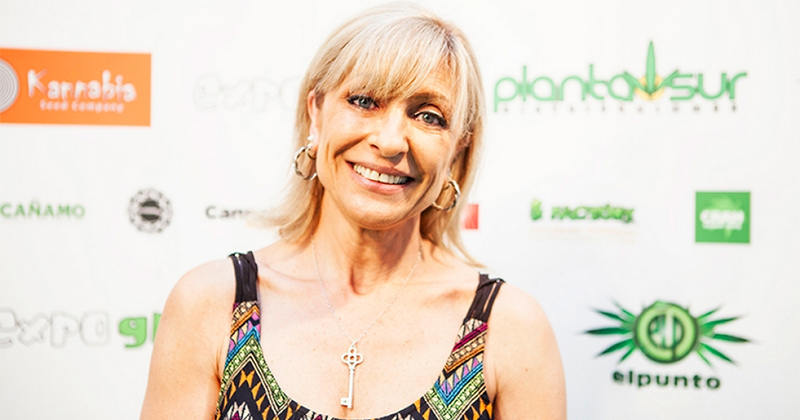
Raquel Peyraube is one of the key figures in cannabis legalization in Uruguay. Her writings and knowledge were fundamental in drafting the Uruguayan law. Raquel was in Paris two weeks ago. We took the opportunity to speak with her.
The French public likely knows you very little. You've been working in the field of drugs for nearly 30 years, in training, prevention, and harm reduction areas...
[cuts us off] I don't work in risk reduction, but in harm reduction. Risk reduction is part of the prohibitionist discourse. The risks are there, we have to learn to manage them, not reduce them. If you reduce risks, you prohibit certain behaviors. So I don't think about risk reduction, but about harm reduction.
… harm reduction, then. You also worked with the Uruguayan government to prepare the cannabis legalization law, and are currently conducting several clinical trials on medical cannabis.
Absolutely. I am also the President of the Uruguayan Society of Endocannabinology. We place the endocannabinoid system at the heart of our work there. Our physiological system, when necessary, must be repaired, modulated, treated, and for that, cannabis is used. It’s a scientific position towards health. We don’t work on the issue of drug policy. But on medical cannabis.
The endocannabinoid system should be at the center of scientific work.
The endocannabinoid system is at the heart of the issues, not cannabis. We study diseases of the endocannabinoid system. I often make this comparison: when you have a deficiency in the endocrine system, you are given external hormones. When you have a deficiency in the endocannabinoid system, you should also be given cannabinoids from the outside; it's the same principle. This is absolutely accepted in medicine. I believe this is one of the lines of work regarding the public stance on medical cannabis. It's not the same issue as adult recreational cannabis use. It has nothing to do with it.
I am also a member of the’International Association for Cannabinoid Medicine. I am part of the committee working on the network's development, and we are appointing ambassador organizations and professional scientists, doctors, institutions, as well as patients and ambassadors in each country. We need to open public discussion on this topic.
What made you want to work in this field?
I started by working on problematic drug use. I'm a doctor and I knew nothing about drugs when I started. I was thinking the way I had been taught. Then European colleagues told me, «What you're doing is harm reduction.» And I thought, «Ah, magnificent, that's what doctors do for everything.».
With my background in toxicology and psychiatry, working in the field, I realized that most of the problems drug users faced did not come from the drugs themselves, but from public drug policies that caused more harm than the substances themselves.
Drug policies have done more harm than the substances themselves.
As I observed heavy users of cocaine and freebase, I noticed that my patients coped very well with withdrawal symptoms if they used cannabis. So I began suggesting that they use cannabis to quit. Years later, I reviewed studies from clinics in Canada and the United States that showed that 50% of users of alcohol, tobacco, methamphetamine, cocaine, and heroin quit using these substances by using cannabis.
So I started to more strongly suggest the use of cannabis, because it was more culturally acceptable and easier for patients to manage. They knew the effects, they knew how to manage them better than medications with psychotropic effects, which in the end were used as a chemical straitjacket.
These people rejected the use of medication, except for getting high, but not as treatment. So we began to negotiate, to try to determine how many puffs were necessary before stopping, how many times a day, and it became a kind of medicalization. I wanted to learn how to access these successes.
It was at our home in Uruguay, and for these reasons, the association Alliance for Uruguay without Drugs wanted to send me to prison. Because according to our internal law, it was promoting consumption. And helping consumers consume better, or inciting drug use.
But no judge prosecuted me because my patients were getting better. They stopped using cocaine, they stopped stealing, they were healthier... So I started to research, to study the research on cannabis and cannabinoids, and I worked a lot on the law and the idea of changing drug policies. The starting point is that the drug problem is linked to prohibition and not to the effects of drugs.
And that's why I wanted to delve deeper into the vision of drug policy and how to deal with cannabis, which was helping me. It was a scandal in my country. I started by telling parents to go buy cannabis on the black market to separate the markets. What I see is that cannabis is not a gateway drug to hard drugs. On the contrary, it helps my patients quit drugs. In this case, we must separate the markets. Holland did it with coffee shops. I don't have a coffee shop, so I told parents to buy cannabis for medical use.
There was no legal framework...
No, that was in the 90s. Parents would tell me, «I'm bringing my child to you so they can stop using drugs, and you're telling me they need to buy them.» But how many treatments has their child gone through so far? Four. So we need to change. And the parents tried. And I saw fathers cry telling me, «Thank you, my child wasn't a criminal, they were suffering, entangled in drugs. But with cannabis, they're studying at home, they're working, and they only use cannabis on the terrace of the house.»
This process was interesting, but very painful for me because the scientific community in Uruguay rejected me. Even though they themselves had poor results with their methods, they did not want to hear this discourse, which was so shocking and disruptive for them.
The cannabis I bought was pressed (bricks made of compressed leaves, stems, and flowers)?
At the time, it was almost exclusively pressed but there have always been growers in Uruguay. Of course, flowers and buds cost more. Even though the pressed it was a mix of everything, it was effective. Patients had to buy the product, I couldn't give it to them. I didn't have any and we couldn't prescribe cannabis.
I was threatened, not by traffickers, not by dealers, but by prohibitionists and people responsible for drug programs who called me all sorts of names: «thief, liar, drug addict,» and even accusations of theft... It was the entire body of prohibitionist institutions and rehabilitation clinic owners whose results and methods I was questioning. And why was I criticizing them? Because they were violating all civil and human rights, and the ethical principles of doctors in how they treated patients.
So, no one wanted to talk to me. But at the same time, the media started listening to this speech, and since I was very disruptive, I came across well on TV. I said things that were really striking, that shocked people, but it worked, and I was then able to gather testimonials from patients who confirmed what I was doing… And I also started studying cannabis a lot more for other medical uses, not just for drug users.
This is how I ended up working on diseases like multiple sclerosis, Parkinson's, epilepsy, pain, cancer...
At this point, we arrive at an interesting aspect of the international debate. Why? Because medical cannabis users also consider themselves to be users of the highest category, whereas recreational drug users are seen as belonging to a different category—even though both groups use cannabis.
There is a certain stigma among users themselves, and many medical activist groups, often parents or families of patients, say, «This isn't for us to get high, it's for us to be treated.»
I think we also need to have a humanist mission on this subject, and that includes the entire population, not just those with epilepsy, Parkinson's, or other illnesses. It concerns everyone.
When you started working on Uruguayan legalization, what was the societal context? What was the public's opinion on legalization? And the politicians'?
Public opinion was overwhelmingly against it, at 62%, and that hasn’t changed. We still have 62% against it, but our system is in place and working. The party that pushed through legalization was re-elected in the last election.
This may stem from the model of legalization. Our model is entirely different, and that has helped us. Our model is not focused on business, but on national security—to prevent corruption and the rise of narco-states—and on public health, particularly for drug users and cannabis users in particular. We thus separate the markets, for the benefit of medical cannabis users, for public health, and for the respect of human rights.
The war on drugs has violated all human rights. And no one thinks about that. Furthermore, when you work in this field, you know that international human rights conventions are hierarchically superior to drug conventions. If you respect drug conventions and violate human rights conventions to do so, you are in a worse international situation. It is always strange to remind countries to respect drug conventions even if they violate international conventions, like Duterte in the Philippines, the crimes, the homicides, to fight drugs. So we tolerate this unique situation in history, even murderers but not users.
What were the successes and failures of the implementation of Law 19.172?
As public opinion shifted, at first we had 29% in favor of medical cannabis and 62% against adult cannabis use. And I began my media campaign, which lasted eight months. Every day I was on TV, giving a medical perspective—not just for patients, but for everyone. And eventually, public opinion shifted. By the time the law was passed, we had 74% in favor of medical cannabis. But opinions on recreational use hadn’t changed.
That's very interesting. If instead of asking «Are you in favor of legalization for adult-use cannabis,» you ask, «Would you prefer your son or daughter to buy cannabis on the black market or from a pharmacy?» the answer isn't the same. There's starting to be a cultural shift.
Consensus is not necessary
It is wrong to think that consensus is necessary to change policies. Often, the prejudices of the general population are distorted. We are talking about a necessary cultural change, knowing how to manage a world with drugs, and this cultural change needs a lot of information.
To date, there has been a lot of disinformation and perverse information intended to create confusion and prejudice. Why? To support a moral, political, and economic state that is not beneficial to the general population. And this image has been created. Changing this idea in the collective imagination is a collective effort that must be made to accept the law.
Uruguay did this, in particular, by providing data that people could understand. For example, regarding schizophrenia, the data show that cannabis use has increased substantially, but that cases of schizophrenia have not increased. So how is it possible that a cause does not increase the consequence if it is increasing itself? That is a line of reasoning the public can understand.
I believe our work has been very interesting. Opinions haven't changed on adult use, but change is happening. It's no longer just older people asking for medical cannabis, but also middle-aged people who want to try cannabis.
Why? Because it's been legalized for three and a half years, and nothing has happened. There have been no problems. The last national census showed that cannabis consumption has decreased in Uruguay, where it continues to increase everywhere else in the world. We have lower numbers than the rest of the world.
We have fully implemented our law today, but its rollout was delayed by our bureaucracy. The bureaucracy in Uruguay is worse than in France, and ultimately aids prohibitionism. Politicians and bureaucrats need to be educated on the subject. The law isn't the only thing blocking change, but the bureaucrats are too. Why? Because they disagree with the new law. Our President, for that matter, is also against drug use. But as a parliamentarian, it's not your personal opinion that matters, it's the law. It's a long process, but we have 6,800 registered users for self-cultivation so far, 59 clubs, and over 4,000 recreational users. here].
Are you more in favor of using the whole plant, or only the active principles?
I am for the use of the whole plant. Phytocannabinoids are better accepted by patients and the’entourage effect enhances the benefits of medical cannabis.
Today we have two tools at our disposal: either inhibitors of endocannabinoid breakdown, or an increase in cannabinoids through external intake. Cannabis is safe and effective for diseases that conventional treatments do not affect.
Medicine today is patient-centered, not product-centered. The use of medical cannabis must be a collaborative effort with the patient to find the minimum effective dose for them. Some individuals react more to myrcene, others to limonene. It's a joint effort.
If you had 5 minutes with Emmanuel Macron, what would you tell him?
I will tell him, «If you want to be re-elected, legalize it, you have to do it.»
France has a history of uncritical, thoughtless prohibition that has caused a lot of damage and legitimized this entire history in a truly terrible way. It was the last country to implement harm reduction. Portugal was the last, but France is very different from Portugal.
If France manages to legalize it, geopolitically, it would be an international, global success. If France changes, the entire world will change. Uruguay was a strategic country. It is a country different from the rest of South America, but with which several central countries identify. Uruguay started the domino effect. In Latin America, 5 countries have now legalized medical use.
France could do the same for Europe, but not only that. In addition, France needs to legalize because it is surrounded by countries that have already legalized medical cannabis: Holland, Germany, and Italy. Spain has not legalized, but the Clubs are a legal cannabis system, although they remain a backdoor system.
France must legalize for political and economic reasons. French investors will go invest in Germany, Holland, and Italy. If you want French money to stay here, you need to create a medical industry. Macron must hear this too. And decrease the cost of public healthcare. And increase investments. Develop a national industry. France also has a long history with hemp and has very good genetic developers for industrial use. France has everything to do it well. It's complex, but France has fertile ground; we didn't have the same at all in Uruguay, and we legalized for humanitarian reasons, for the population. But I believe France is a strategic country.
Today, people who need medical cannabis are outside of your healthcare system. This is not fair, because they are experiencing real benefits that they pay for out of pocket, without health insurance. This approach needs to be included in health insurance.
It's certainly easier for a country of 4 million people to legalize it compared to France with its 70 million inhabitants?
Yes, but at the same time, Uruguay is very conservative. However, we legalized abortion, drugs, euthanasia, all the social reforms, even though all these measures remain difficult to implement in Uruguay. For abortion, it was the same story and we legalized it.
France is accustomed to talking about all these subjects, but no one talks about drugs or cannabis, or medical cannabis. The subject needs to become a permanent fixture. Prohibitionists won't be interested in the subject until you start succeeding. We have to do the work, we have to give the media disruptive talking points to provoke the debate. I've had debates with psychiatrists in Uruguay, and they are the worst. I don't know about here, but they dominate prohibitionism. Psychiatrists are owned by rehab clinics; they are the ones who control drug-using populations, so it's a business, and they use a lot of Big Pharma drugs. In general, they are the worst.
So I used the public debate to ask, «Listen, tell me, explain to the public: has cannabis use gone up?» «Yes, blah blah…» These are dramatic claims, and so on… «And has schizophrenia increased?» And honestly, they don’t know how to answer. And it’s the same percentage as always—11% in South America, 21% in Europe—but cannabis use has increased much more than that. If cannabis use is increasing, I don’t need clinical trials to prove it. Epidemiology shows it. This argument is destructive, absolutely.
Demand for cannabis has increased. That's true. Research has shown that it is not a substance without harm. It has damages. And now, the user who thought they didn't have a problem may be aware that they have developed a problem. But cannabis use is not necessarily problematic use. I have no problem if cannabis use increases. The problem comes from problematic cannabis use.
Legalization has increased usage. Yes. For two reasons: people who couldn't say they used cannabis because it was illegal, risked prison for simple use as in France, and will now say, yes, I use it.
And secondly, because more people will be interested in using medical cannabis. But that's not the problem. The problem is the increase in problematic use. And how can we reduce that? How do we educate our children? How can we consume cannabis without problems?
Just as I did with my children. I myself preferred to raise my children regarding cannabis use and not the dealer, who is only there for profit. Parents have the responsibility to educate their children about alcohol use, cannabis use, about anything. Food use. About everything. Legalization brings about this situation. Parents will be able to talk to their children without being in a position of «no, wait, if you want to use...», you can't say that as a parent.
But if the law supports this discourse, then I can educate, I can help. I believe that this is a very moving story, a change in humanity's position, a more human, sensitive, and rational position. More and more, I'm told, «No, but it's going to be children who will consume.» And yet, let's look at what is happening without legalization: an increase in drug consumption, more dangerous drugs, children and minors starting to consume drugs at increasingly younger ages. So, what do you think about it?
Raquel Peyraube is on Twitter











«Vincy Gold»: Humboldt Seed Company on the Hunt for Saint Vincent Sativas

Cronos Completes the Acquisition of CanAdelaar for 57.5 million euros

Cannabis with a "bloody" twist: Discover Sensi True Blood and Sensi Sangria, the two new strains from Sensi Seeds

Hemp: The Council of the EU Takes a Stand on New Production and Marketing Rules

Missouri's legal cannabis market accounts for 93 % of consumer spending

THC Gummies: How to Read a Certificate of Analysis Before Buying

British patients now have access to THCV-rich cannabis flowers

Spain: Medical Cannabis Is Coming to About 50 Hospitals

JIHE 2026: Japan’s Largest Trade Show Dedicated to Hemp and CBD Returns to Tokyo with More Than 100 Industry Players

New Caledonia: The Courts Clear the Way for the Return of CBD
-
 Business3 weeks ago
The legal cannabis market in New York exceeds 4 billion $ in revenue
-

 Cannabis in France4 weeks ago
Which countries legalized medical cannabis before France?
-
Cannabis in France1 week ago
France already has 3,000 cannabis retail outlets. None of them are legal.
-
Business4 weeks ago
South Korea is preparing to begin local production of medical cannabis to meet rising demand
-
Cannabis in the U.S.1 week ago
A DEA report confirms that there are no fatal cannabis overdoses
-
Cannabis in Thailand4 weeks ago
From the boom in dispensaries to a purely medical approach: Thailand is revising its cannabis policy
-
Cannabis and driving4 weeks ago
Medical Cannabis and Driving: New South Wales Ends Automatic Penalties for THC
-
Cannabis in France3 weeks ago
France’s Drug Policy Chief Defends Cannabis Prohibition... and Runs Into the Facts















steribox
July 15, 2017 at 08:35 PM
No drug is guaranteed to be without «danger,» with each person's symptoms being unique, but none are entirely free from it. .