Study: Ecstasy encourages octopuses to cuddle

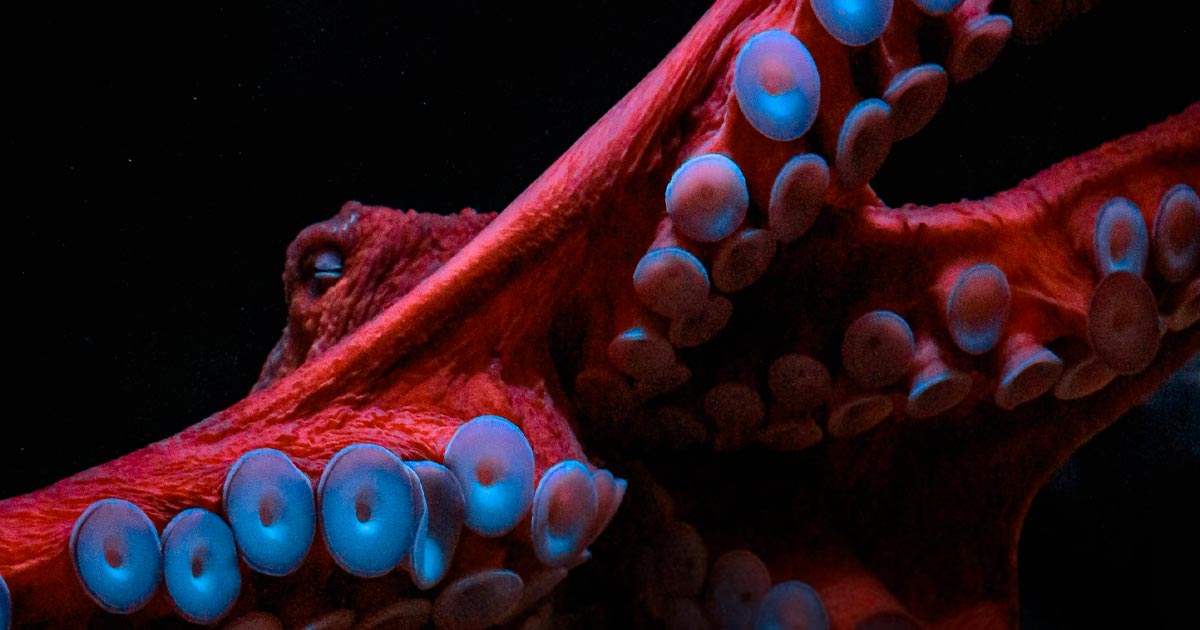
Anyone who's taken MDMA has probably experienced a rush of euphoria and tactile sensation. As it turns out, this is also true of octopuses.
A 2018 study by researchers at Johns Hopkins University, whose findings were presented in an article published this month in Psychedelic Spotlight, tested the «behavioral response to MDMA, or ecstasy, a popular mood-altering drug» in these marine creatures. The experiment transformed the animals' habitat into a kind of underwater rave.
Read more: Project E206: Lock up 20 women for 98 days and make them smoke pot
The principal investigator «designed an experiment with three interconnected water chambers: an empty chamber, a chamber with a plastic figure under a cage, and a chamber with a laboratory-bred female or male octopus».
«Four male and female octopuses were exposed to MDMA by placing them in a beaker containing a liquefied version of the drug, which is absorbed by octopuses through their gills. They were then placed in experimental chambers for 30 minutes. All four octopuses tended to spend more time in the chamber where a male octopus was caged than in the other two chambers,» explains the study.
«Most octopuses are asocial animals that avoid others, including other octopuses. But because of some of their behaviors, Dölen thought there might be a link between the genetics that guide social behavior in them and in humans. He therefore turned his attention to the genomics of neurotransmitters, the signals that neurons transmit to each other to communicate. Gül Dölen and Eric Edsinger, researchers at Marine Biological Laboratory from Woods Hole, Massachusetts, have taken a closer look at the genomic sequence of Octopus bimaculoides, commonly known as the California two-spotted octopus.
The study continues: «Specifically, in the genetic regions that control how neurons attach neurotransmitters to their membranes, Dölen and Edsinger found that octopuses and humans had almost identical genomic codes for the transporter that binds the neurotransmitter serotonin to the neuron membrane. Serotonin is a well-known mood regulator and is closely linked to certain forms of depression».
Dölen, assistant professor of neuroscience at the Johns Hopkins University School of Medicine and principal investigator in charge of the experiments, explained that «octopus brains are more like snail brains than human brains, but our studies show that they can exhibit some of the same behaviors as we do.».
Read more: Most US states to legalize psychedelics by 2037
«What our studies suggest is that certain brain chemicals, or neurotransmitters, which send signals between neurons necessary for these social behaviors, have been conserved during evolution,» said Dölen.
Dölen declared that the long period spent by the octopuses in the experimental chambers was «not only quantitatively longer, but also qualitatively».
«They tended to hug the cage and rest their mouthparts on it,» Dölen explained. «This is very similar to the way humans react to MDMA; they touch each other frequently.»
«Octopuses suspend their antisocial behavior to mate, for example. Then, once mating is complete, they switch to aggressive, antisocial mode,» added Mr. Dölen.
Dölen notes that «the experiments suggest that the brain circuits that guide octopus social behavior are present under normal conditions, but can be suppressed by natural or other circumstances».
Octopuses have long been a source of fascination for marine biologists because of their prodigious intelligence and advanced behavior.
As the Psychedelic Spotlight, In the words of one of its authors, «it's surprising how little science still knows about octopuses». The website highlighted a 2018 study peer-reviewed study on whether animals are aliens.
«So it's not surprising that scientists wanted to know more about octopus consciousness and how they respond to mind-altering substances such as MDMA (3,4-methylenedioxymethamphetamine),» reads the website. «Known for its ability to increase feelings of happiness and closeness, MDMA increases the production of serotonin, a brain neurotransmitter linked to these feelings. The octopus brain is similar to the human brain».



















Medical Cannabis in Germany: THC Prices Vary by a Factor of 12

France already has 3,000 cannabis retail outlets. None of them are legal.

Morocco's exports of legal cannabis have expanded to 15 countries

Aurora Cannabis Doubles Its Production Capacity in Germany

Tilray is accelerating its operations in Europe thanks to a license in Portugal

Boston will host the 10th annual State of the Cannabis Industry Conference on October 26

A DEA report confirms that there are no fatal cannabis overdoses

A British patient is challenging the NHS's refusal to reimburse medical cannabis

October 2026 CBD Highlights: 10 Strains and Hash to Discover from 5 French Producers

CBD in France: Traceability, Retail Stores, THC and Driving… What the New Bill Proposes
-
 Business2 weeks ago
The legal cannabis market in New York exceeds 4 billion $ in revenue
-

 Cannabis in France3 weeks ago
Which countries legalized medical cannabis before France?
-
Business3 weeks ago
South Korea is preparing to begin local production of medical cannabis to meet rising demand
-
Cannabis in Thailand3 weeks ago
From the boom in dispensaries to a purely medical approach: Thailand is revising its cannabis policy
-
Cannabis and driving3 weeks ago
Medical Cannabis and Driving: New South Wales Ends Automatic Penalties for THC
-
Autism3 weeks ago
Autism and Cannabis: Results from the First Placebo-Controlled Trial of NTI164
-
Cannabis in France2 weeks ago
France’s Drug Policy Chief Defends Cannabis Prohibition... and Runs Into the Facts
-
CBD1 week ago
In Brazil, researchers are developing an innovative CBD eye drop
















You must be logged in to post a comment Login