
50 years of interior ministers declaring war on drugs

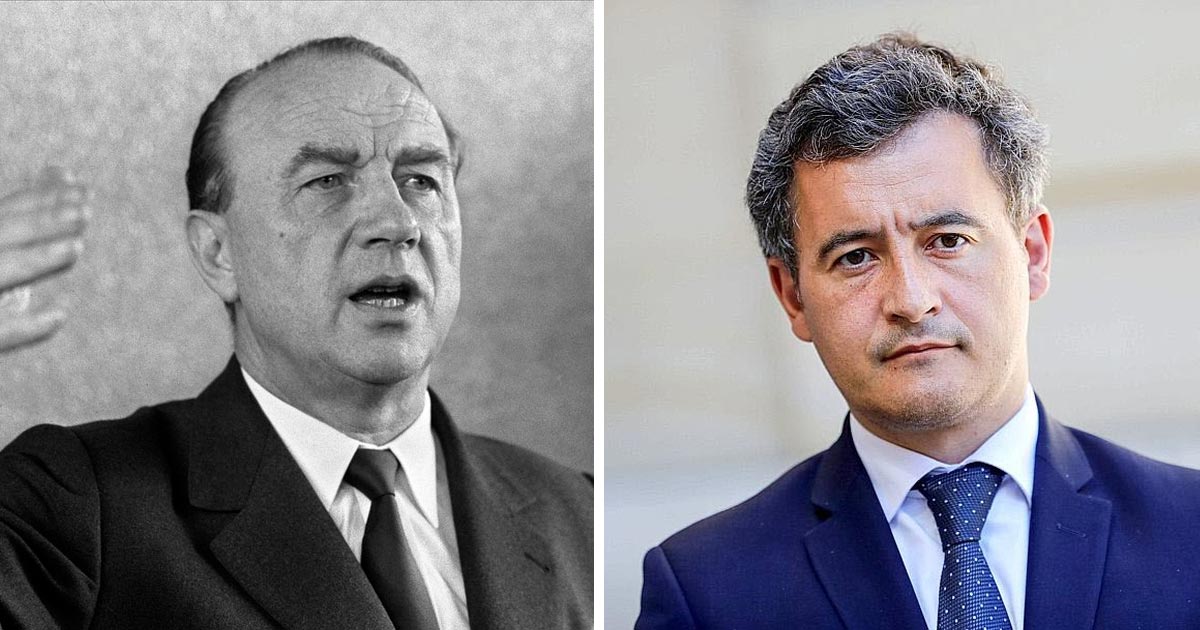
A total of 3,952 drug sales locations have been identified in metropolitan France and the overseas territories by the Ministry of the Interior, Gérald Darmanin said Sunday in an interview with *Le Parisien*. In addition, he announced the creation of a new section on the National Police website to allow citizens to report a drug dealing spot.
«I want the police and the gendarmerie to crack down on every single one of them. I will report each month on the number of drug dealing spots dismantled across the country,» said the Minister of the Interior.
50 Years of the War on Drugs
The ban on narcotics in France will mark its 50th anniversary on December 31. These 50 years have made us the leading consumers of cannabis in Europe today, with annual consumption valued at more than 3 billion € for cannabis alone.
And while one might suspect Gérald Darmanin of engaging in political spin—equating radical Islamism with drug use, seeking both to free citizens from the stranglehold of drug trafficking and, at the same time, shockingly, involving them in the fight against drug trafficking, he is ultimately continuing 50 years of an intensified war on drugs led by the Ministry of the Interior.
The former Minister of the Interior, Christophe Castaner, had also declared war on drug trafficking during a trip to Marseille by four ministers and the announcement of a «new drug plan.' He had also taken the opportunity to rename OCRTIS to OFAST, no doubt to make people forget that the previous French DEA was accused of being one of the leading importers of cannabis in France. Before that, It was the Poulliat Fine that was inaugurated with great fanfare, after a bogus experiment that wasn't even evaluated before it was rolled out on a large scale, while perpetuating a long-standing French tradition of racism born on December 31, 1970.
Raymond Marcellin, then Minister of the Interior, stated on July 26, 1971, that to punish drug traffickers, «we will have to go as far as the death penalty if current penalties are not sufficiently deterrent.»
« The minister thus seeks to strengthen the crackdown on drug trafficking, which had already been made more severe by a law of December 31, 1970. He is thus taking up a proposal by Mr. Gaston Defferre, mayor of Marseille—one of France’s main drug hubs—who, on June 8, had also called for the death penalty. By declaring that the fight against drugs is a »national issue,« Mr. Marcellin echoes the phrase recently used by the President of the United States to describe a threat of ’increasingly alarming proportions.» reads in an article in *Le Monde* dated July 28, 1971.
All of his successors also adopted a martial tone when discussing the fight against drugs—whether against users or trafficking—with the exception of Bruno Leroux and Mathias Fekl, who remained in office for only 4 and 3 months, respectively. Here is a selection:
- Michel Poniatowski (1977) : «There’s a problem in Holland,» he said, “which is that the laws didn’t allow for sufficiently forceful action against drug addicts.”
- Christian Bonnet (1980) : «In fact, there’s no such thing as «soft« drugs and »hard’ drugs. Soft drugs inevitably lead to hard drugs…”. Christian Bonnet also assigned 200 police officers exclusively to the fight against narcotics; another 600 “had been trained to combat drug trafficking, and, finally, that ongoing collaboration with police forces in neighboring and distant countries was bearing fruit in the dismantling of laboratories and networks.”
- Jacques Chirac and Charles Pasqua (1987) : «The Chirac administration did indeed pursue a stricter policy in this area (in part under the influence of Charles Pasqua, Minister of the Interior) than the Socialist administrations that preceded it. Albin Chalandon, who was Minister of Justice at the time, is said to have personally declared a »crusade against drugs,” which was aimed primarily at drug users.”
- Paul Quiles (1989) : «The minister has launched a »full-scale war on drugs,« which has become the »priority» of his ministry’s efforts.» And already we see the trappings of French «firmness»: «Should drug use be legalized to better control consumption and trafficking? […] To these questions—which are of equal concern to public health authorities—the Minister of the Interior intends to provide law enforcement-based solutions. He has instructed the police to rigorously enforce the plan—which is clearly focused on repression—proposed by Prefect Broussard. »France has only one stance toward the global scourge of drugs: firmness,« confirmed Mr. Quilès. »This firm stance is based on a law—the law of December 31, 1970—which has never been called into question and which criminalizes use, resale, and trafficking alike,» the minister continued. “Whether soft or hard drugs, the same repressive measures apply.”
- Philippe Marchand (1991) : « »The fight against drugs remains a priority that justifies the significant resources allocated to it, as well as the ongoing development of international cooperation. Efforts will continue, particularly with regard to monitoring the flow of funds derived from drug trafficking."
- Jean-Louis Debré (1997) : Jean-Louis Debré pointed to a «lax attitude toward drugs» and said, «I wonder if, after experiencing the »caviar left,’ we aren’t now seeing the ‘pot left’ emerge.”
- Jean-Pierre Chevènement (2000): «We must combat drug trafficking even more effectively.»
- Dominique de Villepin (2004) : «That is why the fight against narcotics is a top priority for security in France. In the face of this new threat, we must put new measures in place.»
- Nicolas Sarkozy (2007, (then president): « We must step up the fight against all forms of organized crime, particularly drug trafficking, which is wreaking havoc in a number of our neighborhoods. We must step up the fight against all forms of organized crime, particularly drug trafficking, which is wreaking havoc in a number of our neighborhoods. The underground economy is a threat to our society; it imposes a »non-society” devoid of rights and responsibilities. It leads to the ghettoization of certain areas and holds entire populations hostage—people who are the first victims of these thugs. That is why it must be vigorously combated.”
- Michèle Alliot-Marie (2008) : «Michèle Alliot-Marie declares war on drug dealers and the underground economy in neighborhoods.« “
- Brice Hortefeux (2010) : «Brice Hortefeux Steps Up the Fight Against Drugs»
- Claude Guéant (2011) : «Guéant Wants to «Clean Up» St-Ouen’s Drug Deals»
- Manuel Valls (2012) : «Interior Minister Manuel Valls reiterated on Monday that the fight against drug trafficking is a «constant battle that cannot tolerate any weakness.»”
- Bernard Cazeneuve (2015) : « »Bernard Cazeneuve Steps Up the Fight Against Drug Trafficking in Saint-Ouen"
Lack of originality
France's war on drugs began on December 31, 1970, in a completely different international, scientific, and political context. Nixon was in power in the United States and had launched the the war on drugs, particularly to discredit the Black community. France, like everyone else, had followed the United States in this prohibitionist approach.
Gérald Darmanin didn't come up with anything new, but he didn't break new ground either. If his predecessors failed, will he manage to do better? by using the same recipes ?

















France’s Drug Policy Chief Defends Cannabis Prohibition... and Runs Into the Facts

Cannabis and the Adolescent Brain: French Scientists Make a Key Discovery

EFSA Gives Initial Approval for Synthetic CBD; Natural Extracts Still Pending

Federal Cannabis Reform Once Again on Hold in the United States

Contest: Win a trip to Quebec to experience the hemp harvest firsthand

Bedrocan on Hold Amid Uncertainty Over Medical Cannabis

Newsweed Launches Its Own AI
A new tax of 0.5% could disrupt the hemp industry in Canada

Medical Cannabis and Driving: New South Wales Ends Automatic Penalties for THC

China's Yongji Health Takes Control of Tasmanian Botanics
-
 Cannabis and driving3 weeks ago
Cannabis and CBD: French Drivers Can Now Lose Their License Even Without a Positive Test Result
-

 Cannabis in France1 week ago
Which countries legalized medical cannabis before France?
-
Cannabis in France4 weeks ago
Cannabis Legalization: The LFI Bill Has a Major Problem—THC
-
Cannabis in the Netherlands3 weeks ago
One year after the launch of the Dutch cannabis experiment, the first trends are emerging
-
Business1 week ago
South Korea is preparing to begin local production of medical cannabis to meet rising demand
-
Cannabis in Thailand1 week ago
From the boom in dispensaries to a purely medical approach: Thailand is revising its cannabis policy
-
Cannabis in Argentina2 weeks ago
Argentina Opens Its Market to Hemp Flowers Containing 1% of THC
-
Cannabis in France3 weeks ago
French medical cannabis remains stalled at the Ministry of Health














You must be logged in to post a comment Login