The two sides of CBD: a new model explains its dose- and context-dependent effects


Scientific version Consumer version
Why the CBD (cannabidiol) seem to protect neurons in some cases, while causing cell death in others? A new hypothesis via a theoretical paper by Anthony J. Vasquez Sr. of Delaware Valley University, spotted on Reddit, proposes a unifying response: CBD acts as a mitochondrial stress test, The results are determined not only by the dose, but also by the cell's pre-existing metabolic state.
The two-way model is to clarify what researchers have long described, often vaguely, as «context-dependent pharmacology».
From neuroprotection to apoptosis
Clinical and preclinical research has repeatedly highlighted the paradoxical profile of CBD, sometimes described as biphasic for its dose-dependent effects: energizing in small doses, calming in large doses.
In epilepsy, purified CBD significantly reduced seizure frequency in treatment-resistant pediatric patients (Devinsky et al., 2017). In contrast, laboratory studies show that CBD can induce apoptosis in glioblastoma and other cancer cell lines via mitochondrial disruption (Massi et al., 2013).
It is important to note that these effects sometimes occur in overlapping concentration ranges. As the author writes, this is not simply a question of dose-response, but a phenomenon of contextual response.
The CBD interacts with over 60 molecular targets, including TRPV1, 5-HT1A, PPARγ, GPR55, cannabinoid receptors and mitochondrial proteins such as VDAC1 (voltage-dependent anion channel 1). This molecular promiscuity has made it difficult to clarify the mechanisms involved.
The new framework proposes that the key variable should not be the target alone, but the’mitochondrial state of the exposed cell.
The two-way model
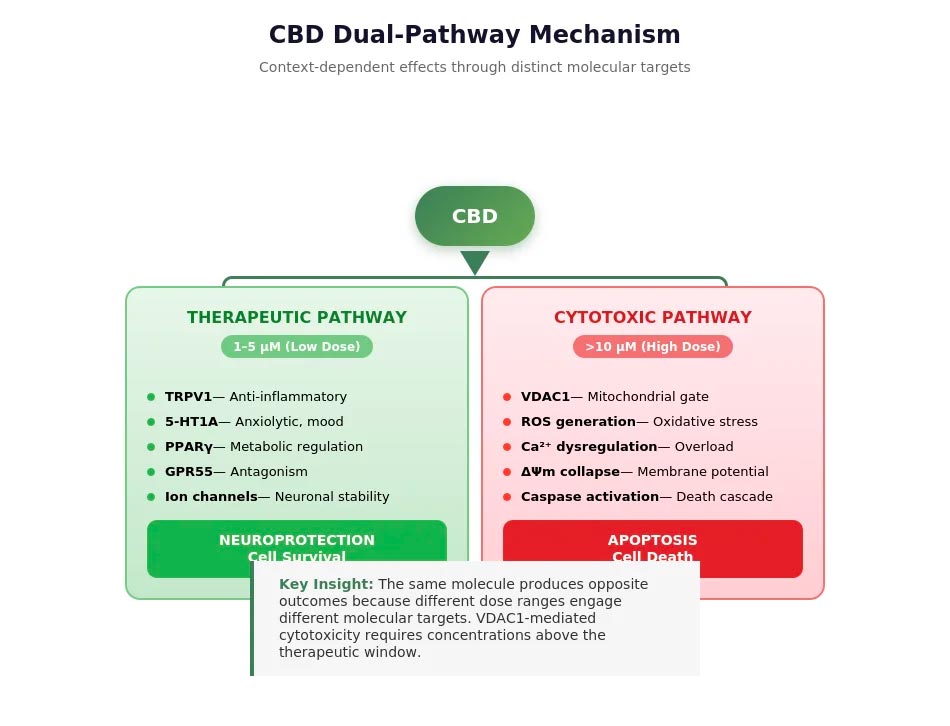
The refined model distinguishes two concentration-dependent mechanisms:
1. Therapeutic route (1-5 μM)
At lower, therapeutically relevant concentrations, CBD preferentially engages with high-affinity targets such as TRPV1, 5-HT1A, PPARγ and GPR55. These interactions are associated with anti-inflammatory, anxiolytic and anti-inflammatory effects. neuroprotectors.
Within this range, mitochondrial disruption is limited, and cells with healthy bioenergetic reserves can absorb the transient stress.
2. Cytotoxic route (>10 μM)
At higher concentrations, CBD achieves significant occupancy of VDAC1, a protein embedded in the outer mitochondrial membrane and often described as the «mitochondrial guardian».
Direct CBD-VDAC1 binding has been measured with a dissociation constant of around 11 μM (Rimmerman et al., 2013). Binding at this level alters mitochondrial membrane potential, disrupts calcium homeostasis and can trigger cytochrome c release, ultimately causing apoptosis.
Cells already under metabolic stress, such as many cancer cells with high reactive oxygen species (ROS) and unstable membrane potential, seem particularly vulnerable. In these systems, CBD can push bioenergetics beyond a survival threshold.
From this point of view, CBD does not selectively «target» cancer cells. Rather, it amplifies the underlying metabolic fragility.
Literature validation and computational convergence
The article reviews over 70 publications examining the cellular mechanisms of CBD. According to the author, 18 of the 20 predictions followed matched the published data, including:
- Rapid mitochondrial effects occurring within minutes of exposure
- Increased sensitivity in metabolically pre-stressed cells
- Attenuation of cytotoxicity with VDAC1 inhibitors such as DIDS or VBIT-4
- Consistent changes in membrane potential, ROS production and calcium flux
In addition to the literature synthesis, the hypothesis was evaluated using a multi-model AI convergence protocol known as the’IRIS Gate Evo. Five major independent linguistic models were interrogated on the research question and reportedly converged on the same two-way structure, including the identification of VDAC1 as a dose-dependent «switch».
While computational convergence does not replace laboratory validation, it does reinforce the internal consistency of the proposed framework.
A critical experimental gap
Despite strong support for the role of VDAC1 in CBD-induced cytotoxicity, the article identifies a notable omission in the literature: no published study has tested whether blocking VDAC1 eliminates the neuroprotective effects of CBD at low doses. This experiment would directly challenge or confirm the two-way model.
If VDAC1 inhibition does not affect neuroprotection, this would support the idea that protective effects are mediated independently by TRPV1, 5-HT1A or PPARγ. If protection is lost, the model should be revised.
Either of these results would clarify the mechanism of CBD.
Clinical implications: metabolic targeting
If validated, the model suggests that therapeutic selectivity could be achieved not by cancer-specific molecular targets, but by the metabolic vulnerability. Tumors with dysfunctional mitochondria could be selectively sensitized to high doses of CBD or to combination treatments that increase oxidative stress.
The framework also highlights biomarkers to predict response, including mitochondrial DNA integrity, tumor metabolic phenotype and CYP450 genetic variants affecting CBD metabolism.
A resistance test, not a miracle solution
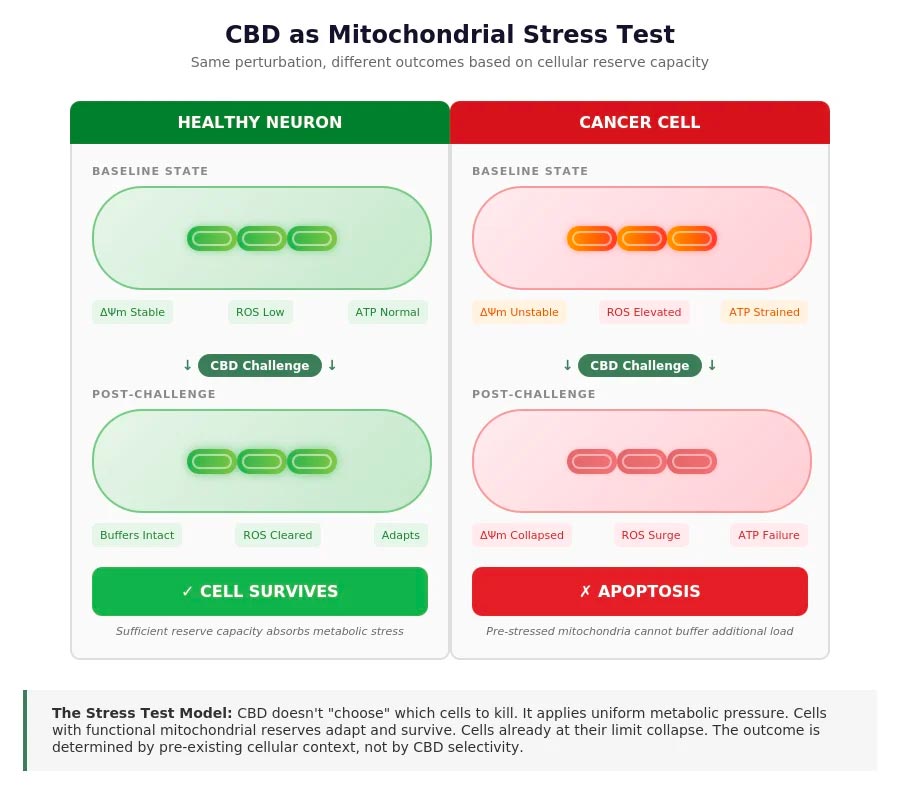
The article concludes that CBD should not be seen as a universally protective or destructive compound. Rather, it functions as a bioenergetic amplifier, revealing whether a cell can withstand metabolic disruption.
For clinicians and researchers, this new approach could help move the debate beyond «context-dependent effects» towards measurable mitochondrial parameters and dose-specific mechanisms.
As the author points out, these results represent a mechanistic hypothesis, not a clinical recommendation. But by linking dose, theVDAC1 commitment and the mitochondrial status within a coherent framework, the two-way model offers a verifiable explanation for one of the most persistent paradoxes in cannabinoid science.
Researchers have long noticed something strange about the CBD In some situations, it helps to protect cells (such as brain cells), and in others, it helps to kill cells (such as certain cancer cells). This seems contradictory. How can the same molecule both protect and destroy?
This new article offers a clear explanation.
The main idea: CBD acts as a «resistance test» for cells
According to the author, CBD does not specifically choose to protect or kill cells. Rather, it exerts pressure on a cell's energy system, in particular on the mitochondria, which are the parts of the cell that produce energy.
What happens next depends on the health of the cell.
- If the cell's mitochondria are strong and stable, it can withstand stress. The cell survives, and may even benefit from it.
- If the mitochondria are already weak or dysfunctional (as is often the case in cancer cells), the additional stress pushes the cell over the edge and it dies.
CBD amplifies what already exists.
Two different effects depending on the dose
The model also indicates that the dose is very important.
Low doses (therapeutic range) :
CBD interacts mainly with receptors such as TRPV1, 5-HT1A and PPARγ.
These interactions are linked to :
- Neuroprotection
- Anti-inflammatory effects
- Reducing anxiety
In this range, mitochondria are not strongly disturbed.
At higher doses :
CBD begins to bind more strongly to a mitochondrial protein called VDAC1.
VDAC1 controls energy flow and plays a role in triggering cell death.
When CBD binds to VDAC1 at higher concentrations:
- Mitochondrial function becomes unstable
- Energy production declines
- Oxidative stress increases
- Cell may enter apoptosis (programmed cell death)
Cells that are already metabolically fragile, like many cancer cells, are particularly sensitive to this effect.
Why is this important?
The article reviewed over 70 scientific studies and found strong arguments in favor of this two-way explanation.
He also points to a missing experiment: no one has yet tested whether blocking the VDAC1 suppresses the protective effects of CBD in neurons. This experiment could confirm or challenge the whole model.
The grand conclusion
CBD is not simply «good» or «bad» for cells.
It behaves more like a biological pressure test:
- Healthy cells can absorb stress.
- Fragile cells can collapse.
The result depends on :
- From the dose
- The metabolic state of the cell
- Molecular targets involved
In short, CBD's effects are not mysterious: they simply reflect the way different cells manage energy stress.





















Dr. Pascal Douek, a tireless advocate for medical cannabis in France, has died

Kentucky now has 26 medical cannabis dispensaries

«Vincy Gold»: Humboldt Seed Company on the Hunt for Saint Vincent Sativas

Cronos Completes the Acquisition of CanAdelaar for 57.5 million euros

Cannabis with a "bloody" twist: Discover Sensi True Blood and Sensi Sangria, the two new strains from Sensi Seeds

Hemp: The Council of the EU Takes a Stand on New Production and Marketing Rules

Missouri's legal cannabis market accounts for 93 % of consumer spending

THC Gummies: How to Read a Certificate of Analysis Before Buying

British patients now have access to THCV-rich cannabis flowers

Spain: Medical Cannabis Is Coming to About 50 Hospitals
-
 Business3 weeks ago
The legal cannabis market in New York exceeds 4 billion $ in revenue
-
Cannabis in France2 weeks ago
France already has 3,000 cannabis retail outlets. None of them are legal.
-
Cannabis in the U.S.2 weeks ago
A DEA report confirms that there are no fatal cannabis overdoses
-
Cannabis in France4 weeks ago
France’s Drug Policy Chief Defends Cannabis Prohibition... and Runs Into the Facts
-
Studies on cannabis2 weeks ago
Cannabis Oil and Endometriosis: A Promising Study for Pain Relief
-
CBD3 weeks ago
In Brazil, researchers are developing an innovative CBD eye drop
-
Business2 weeks ago
Tilray is accelerating its operations in Europe thanks to a license in Portugal
-
Cannabis in France2 weeks ago
CBD in France: Traceability, Retail Stores, THC and Driving… What the New Bill Proposes















cbdtech
February 13, 2026 at 9:23 p.m.
This is an essential article that reminds us of an often overlooked fact: CBD does not act in a linear fashion. This ‘bell-shaped’ model (biphasic curve) explains why increasing doses is sometimes counter-productive, and can even generate effects opposite to those sought.
Understanding that efficacy depends as much on dosage as on the individual's physiological context is a major step towards responsible consumption. It confirms the importance of the ‘low and slow’ approach: start with low doses and gradually adjust to find your own therapeutic window. This is essential technical reading if you want to get away from simplistic marketing.