Spain: Podemos prepares a law to regulate cannabis in 2019

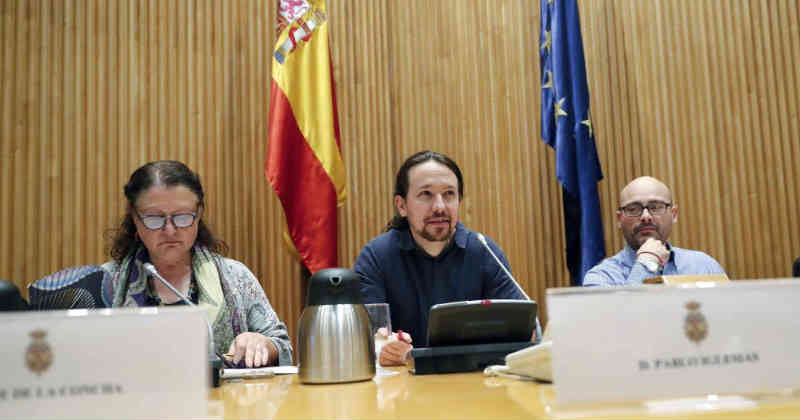
The Spanish party Unidos Podemos organized a forum yesterday at the Congress of Deputies entitled «Towards the integral regulation of cannabis». Its leader, Pablo Iglesias, took part. reiterates its pro-legalization stance and sees the meeting as «the starting point» for drafting a law that the party hopes to present to the Spanish Parliament in the early months of 2019.
«Legalization is only a matter of time».»
«It's no longer a question of whether there's a global debate on the cannabis regulation, That phase has already passed, and the debate today is about who will be the next to regulate cannabis,» says Pablo Iglesias. In his speech, he insists that the regulation of cannabis on a global scale has become a matter of course, and that Spain could greatly benefit, socially, economically and symbolically, from being among the pioneers in this field. His ambition is for Spain to follow in the footsteps of Canada and Uruguay and become a «reference in Europe».
The debate, which lasted more than 5 hours, focused on three themes:
- international experiences with cannabis regulation and the global paradigm shift
- the scientific and health perspective on cannabis
- potential production models and their economic impact
According to Pablo Iglesias, the social and economic benefits of regulation are well established: among other things, it enables product quality to be controlled, the black market and drug trafficking to be effectively combated, tax revenues to be generated for the State, jobs to be created and young people to be protected. He takes the example of states that have already legalized, and highlights the positive figures. On the subject of tax benefits, for example, he points out that in the USA, the states of Washington and Colorado have already collected over $300 million in taxes. Finally, he calls for respect for individual freedom: «the freedom of responsible, informed adults to smoke their bangers as they would drink a glass of wine, without being stigmatized or prosecuted».
How should cannabis be regulated?
After acknowledging that regulation is imminent, the leader of the Podemos raises a crucial question: that of the regulatory model. On this point, he wants to break away from the Canadian model and opt for a sector managed by the State as a public service. The State would be responsible for granting licenses, and would only issue them to certain beneficiaries, with the aim of creating social wealth rather than economic growth. This would, for example, revitalize the agricultural sector and rural areas.
He proposes to grant licenses first to farmers who practice monoculture or to farmers who have had poor harvests, the latter could be allowed from one year to the next to plant cannabis to compensate for low incomes. Other proposals include self-cultivation and cooperative cultivation in small or medium-sized farming structures to «avoid the monopolies and oligopolies of big business».
Iglesias is clear on this point: he doesn't want production to fall into the hands of large multinationals. Although he didn't explicitly mention the Social Clubs, it seems that this is what he's referring to when he mentions «cooperative culture» and the maintenance of citizen initiatives, a way of maintain and regulate the current distribution system.
Ciudadanos traditionally supports such initiatives. But it will be less easy to convince Spain's two traditional parties, the PSOE (Socialist Party) and the PP (People's Party), which are more conservative on the subject. The latter did, however, agree to the formation of a permanent commission within Congress to discuss the future of Spanish cannabis. whose legal status is as unclear as ever.











Medical Cannabis in Germany: THC Prices Vary by a Factor of 12

France already has 3,000 cannabis retail outlets. None of them are legal.

Morocco's exports of legal cannabis have expanded to 15 countries

Aurora Cannabis Doubles Its Production Capacity in Germany

Tilray is accelerating its operations in Europe thanks to a license in Portugal

Boston will host the 10th annual State of the Cannabis Industry Conference on October 26

A DEA report confirms that there are no fatal cannabis overdoses

A British patient is challenging the NHS's refusal to reimburse medical cannabis

October 2026 CBD Highlights: 10 Strains and Hash to Discover from 5 French Producers

CBD in France: Traceability, Retail Stores, THC and Driving… What the New Bill Proposes
-
 Business2 weeks ago
The legal cannabis market in New York exceeds 4 billion $ in revenue
-

 Cannabis in France3 weeks ago
Which countries legalized medical cannabis before France?
-
Business3 weeks ago
South Korea is preparing to begin local production of medical cannabis to meet rising demand
-
Cannabis in Thailand3 weeks ago
From the boom in dispensaries to a purely medical approach: Thailand is revising its cannabis policy
-
Cannabis and driving3 weeks ago
Medical Cannabis and Driving: New South Wales Ends Automatic Penalties for THC
-
Cannabis in Argentina4 weeks ago
Argentina Opens Its Market to Hemp Flowers Containing 1% of THC
-
Autism3 weeks ago
Autism and Cannabis: Results from the First Placebo-Controlled Trial of NTI164
-
Cannabis in France2 weeks ago
France’s Drug Policy Chief Defends Cannabis Prohibition... and Runs Into the Facts

















You must be logged in to post a comment Login