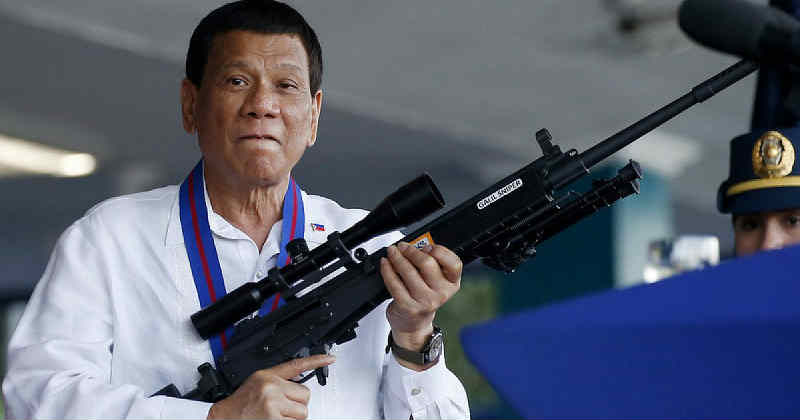
Since taking office in 2016, Philippine President Rodrigo Duterte has undertaken a real war on drugs which has claimed tens of thousands of lives. National and international human rights organizations have sounded the alarm and are calling it a crime against humanity. As part of legal proceedings, The Supreme Court ordered the release of police documents concerning the killings of suspects. A review of these documents could shed light on cases of extrajudicial killings.
The Philippine President's Killing Spree
According to the official figures of the Philippine Drug Enforcement Agency, more than 5,000 people lost their lives in clashes with law enforcement between July 2016 and November 2018. Official statistics also report 164,265 arrests during 115,435 anti-drug operations across the country during the same period. However, human rights organizations and groups supporting victims and their families say these figures are significantly underestimated. They estimate that that the war on drugs has actually claimed between 12,000 and 20,000 lives.
Civil society organizations are pointing to the numerous undocumented executions carried out by unofficial militias. In June 2018, Duterte announced his intention to arm the leaders of barangay, the smallest administrative unit in the Philippines. He wanted to to give 42,000 weapons to civilians. In particular, he had admitted to killing the suspects himself while he was mayor of Davao and called on the public to do the same. Finally, he argued lowering the age of criminal responsibility to nine years (instead of 15) so that children involved in drug trafficking are systematically imprisoned.
Paradoxically, the president had, for a time, stated that he would support initiatives to legalize medical cannabis before to retract. His war on drugs continues to rage, but it is drawing less and less attention. In late 2018, a local court was found guilty three police officers for the murder of a 17-year-old high school student. In addition to its brutal nature, it has been widely criticized for disproportionately targeting poor populations and for its ineffectiveness against organized crime. The thousands of victims have led to the filing of two complaints alleging mass murder with the International Criminal Court (ICC). In response, the president recently withdrew the Philippines from the ICC.
Case Before the Supreme Court
The Supreme Court has been petitioned by two human rights groups: Free Legal Assistance Group and the Center for International Law. After holding public hearings, the court ordered that the police reports from the anti-drug campaign, as well as the list of victims of police raids between July 1, 2016, and November 30, 2017, be handed over to the organizations so that their legal experts could review them. Philippine Solicitor General Jose Calida complied with the court’s decision but condemned the action of the two civil society organizations as an effort to undermine national security and law enforcement operations.
«This is a major step forward for transparency and accountability,» explains Jose Manuel “Chel” Diokno, who heads the group Free Legal Assistance. « »This is a categorical statement by the country's court that it will not allow the war on drugs to undermine the rule of law. This is a very important decision," added Joel Butuyan, president of the Center for International Law. «These documents are the first step on a long road toward justice for the petitioners and for the thousands of victims of the «war on drugs» and their families. The court must also rule on an initiative seeking to have the war on drugs declared unconstitutional.”.

































You must be logged in to post a comment Login