Canada: cannabis stocks swell and threaten to drive down prices

If the first year of Canadian legalization was marked by a shortage of, the trend seems to be reversing. Canada is now facing a cannabis surplus that threatens to drive prices down, while the fledgling industry is still struggling to make a profit.
Strong, steady growth in inventories of unfinished products
Health Canada defines unfinished inventory as «all dried cannabis in inventory held by a licensed grower or processor that is not packaged and ready for sale». According to Health Canada data, This stock (in light green) is growing much faster than sales (in violet):
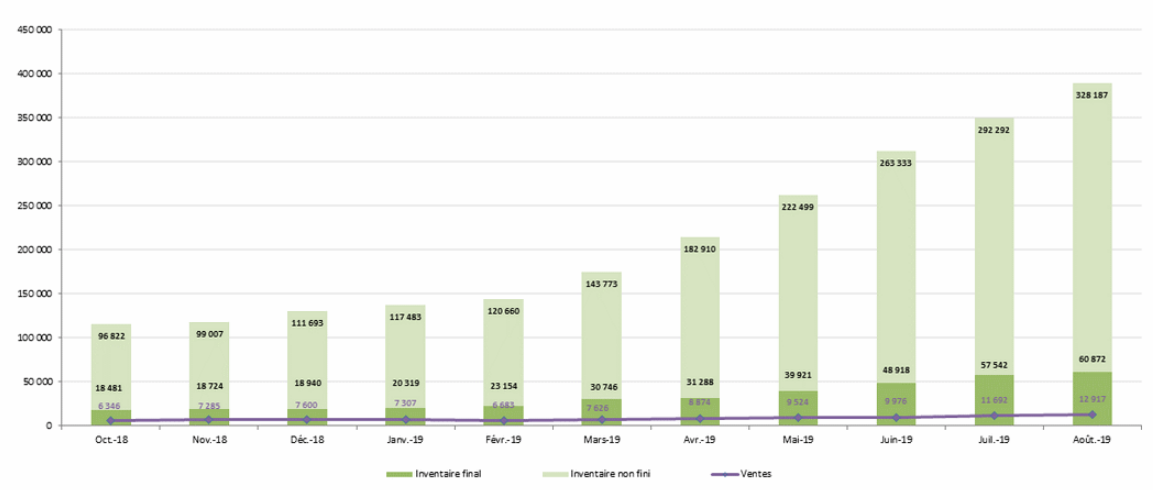
Between the start of legalization and August 2019, the inventory of unfinished products more than tripled, and has been growing exponentially since March. August 2019 finished goods inventory is already 5 times sales for the month. Total inventory represents 30 times sales. If sales were to stagnate at 13,000 kilograms a month, this stock could supply the market for over 2 years.
However, unfinished stock also includes manicure waste such as leaves and stems. What's more, despite slow growth, sales have been rising steadily since March 2019. They will therefore absorb part of the potential surplus.
A race to the bottom?
For some time now, the major Canadian producers have been working to expand their production areas in order to produce more at lower cost and offer more competitive prices. Aurora Cannabis, whose production capacity currently stands at 150,000 kilos/year, plans to expand to 500,000 kilos/year by 2020. This capacity will match that of Canopy Growth, also on track to reach 500,000 kilos/year.
«There's a lot of capacity and a lot of funding to add more, so this will inevitably lead to a moment of supply balance, then oversupply.», explains Tom Adams, BDS analyst. However, if the combined production capacity of producers exceeds the absorption capacity of the legal consumer market by too much, the surplus generated will lead to a fall in prices. This is the law of supply and demand.
For Matt Bottomley, I think there will be a race to the bottom in terms of prices, because now everyone has enough stock«. Some producers have already begun to lower their prices: Hexo Corp has just offered a new line of products (Original Stash) at 4.49$, i.e. 50% below the average price per gram on the legal market.
If prices fall too much, producers will sell at a loss. So it's in their interest not to produce too much. Hexo Corp, for example, has announced the closure of one of its greenhouses and the suspension of its expansion project. Another option is to sell the surplus on wholesale markets to avoid a drop in consumer prices. According to Forbes analyst Stephen McBride, Aurora practices this form of dumping.
«When we look at Aurora's most recent financial reports, we see that its revenues increased by 52% in the last fiscal quarter compared to the previous one. But this hides a dirty secret. The company has dumpé the equivalent of $20 million worth of cannabis, representing an increase of 869% compared to the previous fiscal quarter. The reason she's doing this is because there's not enough demand from consumers».
For Matt Bottomley, on the other hand, supply is not so much out of step with growing demand. «I don't think there's a surplus of cannabis in inventory that the demand from the illicit cannabis market can't absorb,» he explains. «I think the problem is that our distribution infrastructure and online product offering aren't developed enough to be able to attract people who come through the illegal channels.».






















«Vincy Gold»: Humboldt Seed Company on the Hunt for Saint Vincent Sativas

Cronos Completes the Acquisition of CanAdelaar for 57.5 million euros

Cannabis with a "bloody" twist: Discover Sensi True Blood and Sensi Sangria, the two new strains from Sensi Seeds

Hemp: The Council of the EU Takes a Stand on New Production and Marketing Rules

Missouri's legal cannabis market accounts for 93 % of consumer spending

THC Gummies: How to Read a Certificate of Analysis Before Buying

British patients now have access to THCV-rich cannabis flowers

Spain: Medical Cannabis Is Coming to About 50 Hospitals

JIHE 2026: Japan’s Largest Trade Show Dedicated to Hemp and CBD Returns to Tokyo with More Than 100 Industry Players

New Caledonia: The Courts Clear the Way for the Return of CBD
-
 Business3 weeks ago
The legal cannabis market in New York exceeds 4 billion $ in revenue
-

 Cannabis in France4 weeks ago
Which countries legalized medical cannabis before France?
-
Cannabis in France1 week ago
France already has 3,000 cannabis retail outlets. None of them are legal.
-
Cannabis in the U.S.1 week ago
A DEA report confirms that there are no fatal cannabis overdoses
-
Cannabis in Thailand4 weeks ago
From the boom in dispensaries to a purely medical approach: Thailand is revising its cannabis policy
-
Cannabis and driving4 weeks ago
Medical Cannabis and Driving: New South Wales Ends Automatic Penalties for THC
-
Cannabis in France3 weeks ago
France’s Drug Policy Chief Defends Cannabis Prohibition... and Runs Into the Facts
-
Studies on cannabis2 weeks ago
Cannabis Oil and Endometriosis: A Promising Study for Pain Relief

















You must be logged in to post a comment Login