
50 years ago, the Beatles were already campaigning for the legalization of cannabis


It was July 24, 1967. The Beatles, rock icons who left their mark on several generations, were already campaigning to legalize cannabis, alongside other British celebrities and notable figures.
According to the music website Ultimate Classic Rock, the famous Liverpool band and their manager Brian Epstein were among the signatories of a full-page advertisement in the newspaper The London Times, dated July 24, 1967. No fewer than 64 signatories had signed the petition calling for reform of cannabis laws in the United Kingdom.
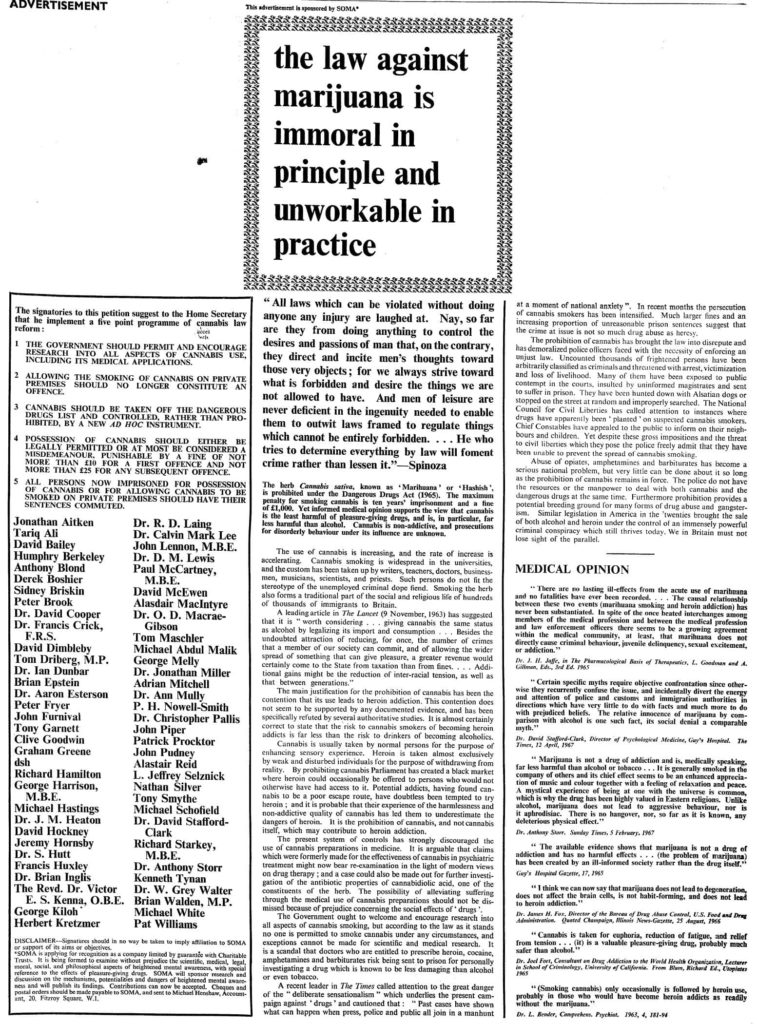
A page from The London Times, July 24, 1967. Fifty years ago, The Beatles and other public figures were already calling for cannabis laws to be reformed.
«The law against cannabis is immoral in principle and unworkable in practice.»
This announcement was made following the arrest of John Hopkins, a famous English photographer and journalist, for possession of cannabis. During his trial, he stated that cannabis «was harmless and that the law needed to be changed.» He was sentenced to nine months in prison. In the wake of this event, The Beatles sought to draw attention to the issue in order to demonstrate that they considered the country’s public policies to be unnecessarily harsh.
John Lennon, Paul McCartney, Ringo Starr, and George Harrison signed this petition, stating that cannabis is «the least harmful of all drugs and, above all, less harmful than alcohol.» This ad aimed to show that, in addition to calling for legal reform, cannabis was not just for the stereotypical “stoner,” but that people from diverse backgrounds could use it.
«Cannabis use is widespread on college campuses, and the practice has been adopted by writers, teachers, doctors, businesspeople, musicians, scientists, and priests. These people do not fit the stereotype of the unemployed criminal,» the op-ed states.
Although the text was not followed by any real reform of cannabis laws, it sparked a public debate that led to some modest changes. For example, the 1971 British Act on the Drug Abuse has been amended. The maximum prison sentence for simple possession of cannabis had increased from ten to five years.
Mehdi Bautier











CBD is said to promote athletic recovery, without improving performance

294 cannabis clubs in Chile: a booming movement with uneven distribution

Chronic Sciatica: New York Approves First Clinical Trial of a THC-Based Medication

United States: The DEA is accelerating the integration of medical cannabis at the federal level

Florida is nearing one million patients using medical cannabis

Uruguay Revives Its Plan to Allow Tourists to Legally Access Cannabis

In Brazil, researchers are developing an innovative CBD eye drop

Autism: Medical Cannabis Is Linked to Reduced Anxiety

The $28 billion U.S. hemp market remains under threat

Jamaica Eases Small Farmers' Access to the Cannabis Market
-
 Business5 days ago
The legal cannabis market in New York exceeds 4 billion $ in revenue
-
Cannabis and driving4 weeks ago
Cannabis and CBD: French Drivers Can Now Lose Their License Even Without a Positive Test Result
-

 Cannabis in France2 weeks ago
Which countries legalized medical cannabis before France?
-
Business2 weeks ago
South Korea is preparing to begin local production of medical cannabis to meet rising demand
-
Cannabis in the Netherlands4 weeks ago
One year after the launch of the Dutch cannabis experiment, the first trends are emerging
-
Cannabis in Thailand2 weeks ago
From the boom in dispensaries to a purely medical approach: Thailand is revising its cannabis policy
-
Cannabis in France4 weeks ago
French medical cannabis remains stalled at the Ministry of Health
-
Cannabis in Argentina3 weeks ago
Argentina Opens Its Market to Hemp Flowers Containing 1% of THC

















You must be logged in to post a comment Login