The structure of the first cannabinoid receptor revealed

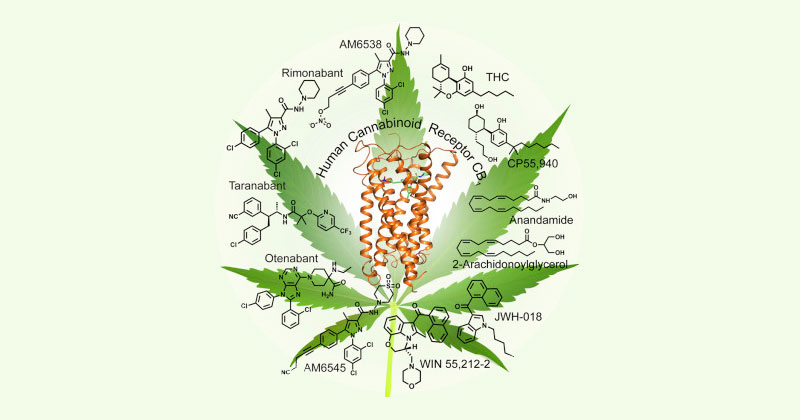
Scientists have known since the 1960s that THC molecules—the psychoactive substance in cannabis—bind to and activate receptors known as CB1. They now have a three-dimensional view of them.
The authors of the paper, published Thursday in the Cell journal, explain that this information is crucial for improving our understanding of this receptor as cannabis becomes more popular and is legalized in some places.
Understanding the structure of the CB1 receptor will provide a better understanding of how various substances bind to it, which explains the effects of cannabis on humans. It may also lead to the development of more effective cannabis-based medications.
«What’s important is to understand how different molecules bind to this receptor, how they control the receptor’s function, and how this can affect different people,» says Raymond Stevens, the study’s co-author.
«All of a sudden, we have the building’s floor plans,» explains Dr. Mark Ware, director of the Canadian Consortium for Cannabinoid Research. «We can figure out ways to get into the building; we know where the windows and doors are, and we now have a pretty good idea of how the building is structured.».
CB1 and synthetic cannabis
This discovery is also an important step toward understanding the differences between the natural cannabinoids found in the plant and synthetic cannabinoids created in a laboratory.
Some synthetic cannabinoids are used in medicine, but certain versions are sold as drugs, under the name Spice or K2.
«While there have been no documented cases of THC or cannabis overdoses, there have been cases of severe or fatal reactions to the ingestion of such synthetic combinations, leading to national restrictions in many countries, including the United States,» the study states. In France, we recall the clinical trial in Rennes which had gone wrong.
Synthetic THC may «prove to be toxic»
Raymond Stevens attributes these potentially harmful effects to differences in receptor behavior depending on whether the cannabinoid is natural or synthetic, even though synthetic cannabinoids are normally designed to mimic natural ones.
«It remains unclear why THC can have such a high margin of safety, while synthetic cannabinoids can be toxic and cause such a wide range of side effects.».
More research is needed
While the use of cannabinoids in medicine is becoming more common, there are still many unknowns in our understanding of how this drug—whether natural or not—actually works.
Most of the information about the benefits of cannabis come from patients, rarely from clinical studies.
«Cannabis affects so many different conditions that it is not possible to conduct clinical studies on all the conditions that patients report being treated with cannabis,» says Dr. Mark Ware.
«That doesn't mean cannabis isn't effective, but rather that we haven't—and haven't had—the necessary investment in terms of time and money to conduct the studies needed to gain a better understanding of these clinical trials.».
«But as a clinician—and as someone who sees patients asking questions about cannabis every day—we need to be able to translate some of this basic scientific knowledge into clinical information that can educate patients.».






October 2026 CBD Highlights: 10 Strains and Hash to Discover from 5 French Producers

CBD in France: Traceability, Retail Stores, THC and Driving… What the New Bill Proposes

Organigram Enters the Race for Aurora Cannabis

Medical Cannabis: Augur Associates’ latest report provides an update ahead of the publication of the decrees

Golden Buds is relaunching its Nova High vape pens with a cannabinoid formula that’s out of the ordinary

Cannabis is now Canada's fifth-largest commercial crop

Bedrocan Finally Declared Bankrupt

After CBD, Can Wellness Exist Without Cannabinoids?

Uganda Launches a Cooperative Dedicated to Medical Cannabis

Ukraine: First Cancer Patient Prescribed Medical Cannabis
-
 Business1 week ago
The legal cannabis market in New York exceeds 4 billion $ in revenue
-

 Cannabis in France3 weeks ago
Which countries legalized medical cannabis before France?
-
Business3 weeks ago
South Korea is preparing to begin local production of medical cannabis to meet rising demand
-
Cannabis in the Netherlands4 weeks ago
One year after the launch of the Dutch cannabis experiment, the first trends are emerging
-
Cannabis in Thailand3 weeks ago
From the boom in dispensaries to a purely medical approach: Thailand is revising its cannabis policy
-
Cannabis and driving3 weeks ago
Medical Cannabis and Driving: New South Wales Ends Automatic Penalties for THC
-
Cannabis in Argentina4 weeks ago
Argentina Opens Its Market to Hemp Flowers Containing 1% of THC
-
Autism3 weeks ago
Autism and Cannabis: Results from the First Placebo-Controlled Trial of NTI164

















hiighlife
October 26, 2016 at 8:51 a.m.
»In France, people remember the clinical trial in Rennes that went wrong.» Except that, contrary to what had been reported, that study had nothing to do with cannabis.
NewsWeed
October 26, 2016 at 9:32 a.m.
Exactly. The clinical trial in Rennes was testing synthetic cannabinoids.
RICCO
October 31, 2016 at 12:08 p.m.
Synthetic cannabinoids? Wasn't that actually BIA 10-2474, an enzyme inhibitor that blocks FAAH (fatty acid amide hydrolase), which breaks down the endocannabinoid anandamide? A little more accuracy, please 😉
RICCO
October 31, 2016 at 12:08 p.m.
Synthetic cannabinoids? Wasn't that actually BIA 10-2474, an enzyme inhibitor that blocks FAAH (fatty acid amide hydrolase), which breaks down the endocannabinoid anandamide? A little more accuracy, please 😉